Biennale Architecttura 2018
June 2018
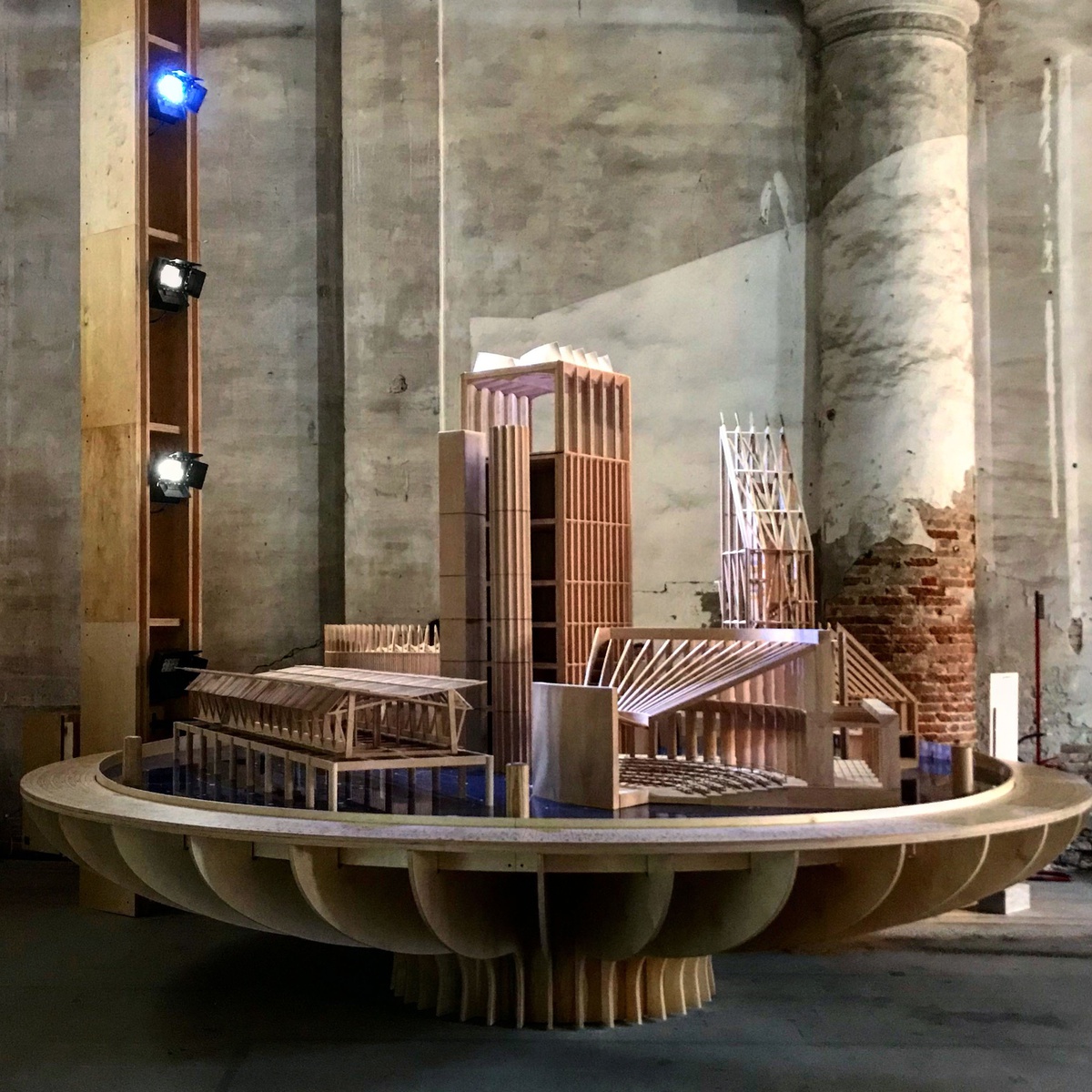
The 2018 Venice Biennale opened to the public on the 26th May. This year’s theme “focuses on architecture’s ability to provide free and additional spatial gifts to those who use it and on its ability to address the unspoken wishes of strangers”.
Our contribution is a collection of six large-scale models, each representing a hall for gathering that the practice has designed. These models are placed upon a rotating table which is a calendar and a cosmic machine. Each hall has a different purpose yet they all bring people together in a rhythmic and cyclical fashion daily, weekly and annually. The specific uses of each building are regulated by a calendar of events, rituals and times of congregation. Their calendars are inscribed on the outer rim of a turning table. The table can be rotated by hand. When you turn it, varying light falls upon the models representing the passage of the sun through the day from dawn to dusk. It is a manual and mechanical process.
The intention of presenting these models in this way is to emphasise the relationship between the enduring frames of the buildings and the endless procession of fugitive elements that pass through them periodically.
A Day Out Of The Office
May 2014
We breathlessly boarded the 08.55 to Darlington. Like skilled waitresses we had kept our homemade, oversized, A1 box perfectly level throughout our chase through Kings Cross Station. The immaculate foam-board creation fitted perfectly on top of a double-seat on the near-empty train. East-Coast mainline rules are clear however; the guard reminded us that seats are for people only and at Peterborough we were duly ordered to deliver our carefully crafted friend to the dedicated luggage wagon at the front of the train.
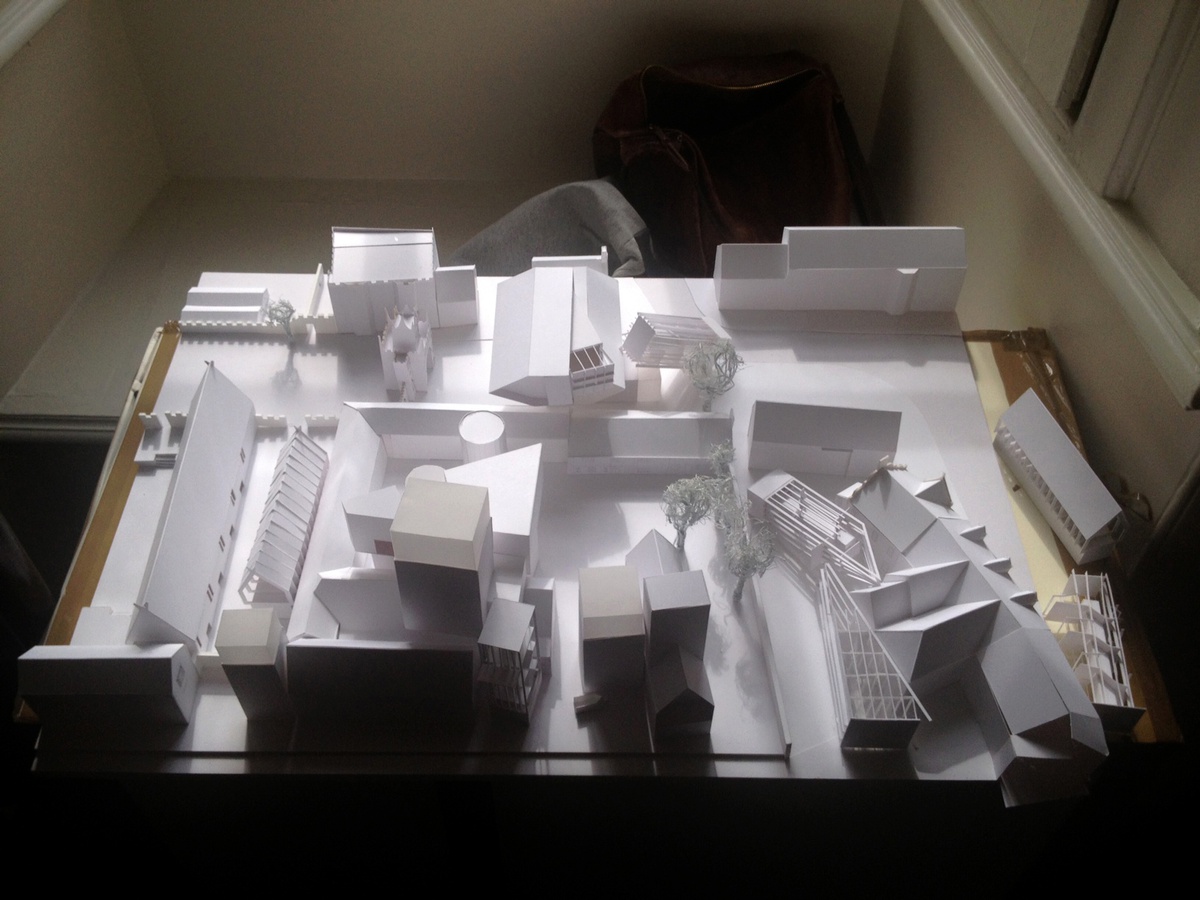
The box was purposefully constructed to house a 1:150 context model of Bishop Auckland Town Square with ‘slot-inable’ building options for the site in question. The model was made for a meeting with Durham County Council and English Heritage at Auckland Castle that same afternoon.
Despite our ticket inspector’s fussiness, we were carried to our destination with the box and its contents in good order.
After a communal lunch with the review panel, the dozen-odd experts collected themselves around a table where the model had been assembled. The object took up so much space that notebooks occasionally and apologetically slid from the edges of the table.
For the following three hours, a multitude of building blocks representing different proposals for the new Welcome Building were inserted into the corner site. The new building is to link town and castle, engaging the new with the old, with our site at the axis of this pirouetting dance.
As we waltzed around the model, interchanging different pieces into our self-made jigsaw, a negotiation occurred between the many different people around the room, a parallel perhaps to the building itself.
During the second part of the afternoon, the presentation became more conceptual. The tower – the key feature of the proposal – was discussed in its meaning, shape and materiality. Was it a campanile, a siege tower, a lighthouse or a scaffold? Each version was debated with varying levels of approval or skepticism. We answered questions by pulling off bits of white card or finding any handy props to add on to the model; notepads, milk jugs and i-phones were used.
We left the meeting feeling excited, there was only this box to get all the way back to the office.
Image shows part of the paper model, with multiple versions scattered about, sitting on a windowsill after the meeting.
Anne Schroell studied at the Bartlett School of Architecture. She worked for Tonkin Liu and De Matos Storey Ryan as well as practices in Luxembourg and Austria before joining Niall McLaughlin Architects in 2006. The main projects Anne worked on are Deal Pier Café in Kent, Somerville College Student Accommodation in Oxford, Peabody Housing in London. She is currently running the Auckland Castle project which consists of 2 new buildings. One is a new gallery attached to the castle and the other is the Welcome Building and Tower for orientation and ticketing.