NMLA Announced as Winners for The Museum of Jesus’ Baptism Competition
February 2026
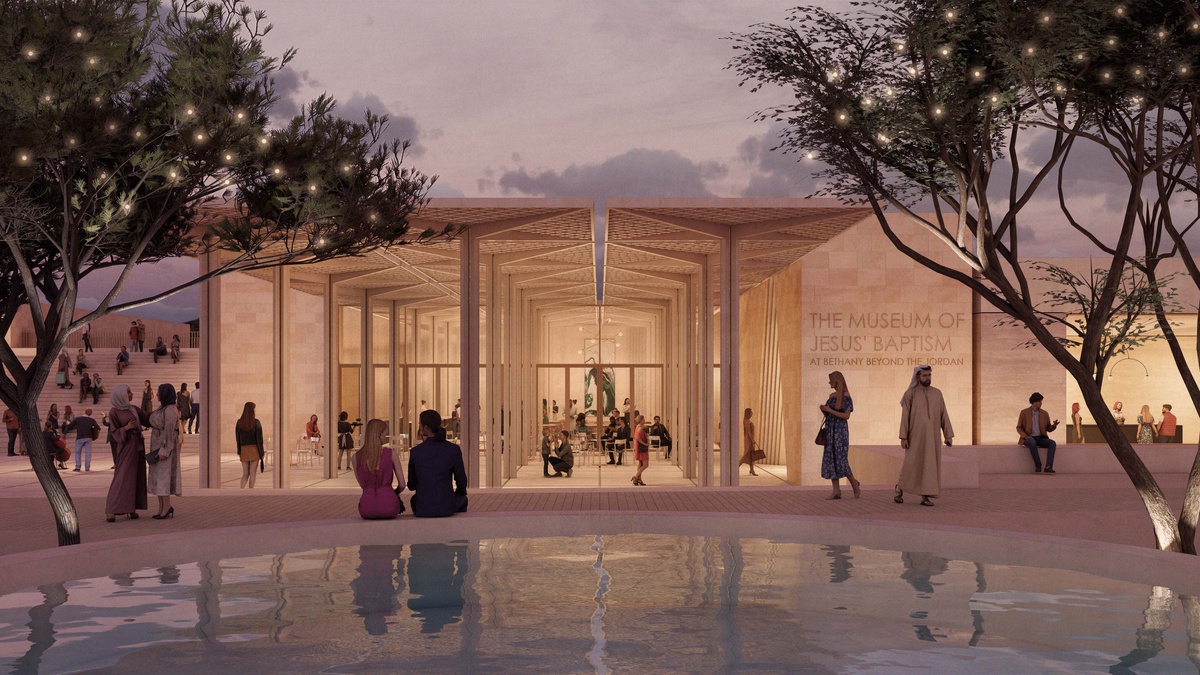
We are delighted that our practice has been announced as the winner of the Malcolm Reading Consultants international competition The Museum of Jesus’ Baptism at Bethany, Jordan.
Our winning concept impressed the Foundation and the Advisory Panel with “its flair for multi-layered and immersive storytelling that focuses on communicating baptism’s power to offer spiritual renewal and new life.” In scale and form, the proposal answered the brief’s call for a museum that ‘evokes wonder and humility in the visitor and responds sensitively to the site’.
Dr Tharwat Almasalha, Chair of the competition’s Advisory Panel and Chair of the Foundation’s Board, said:
‘We congratulate Níall McLaughlin’s team on their proposal which excels in telling the story of baptism – highlighting its power to offer spiritual renewal and new life.
‘We look forward to celebrating the bimillennial of Christ’s baptism in 2030 with the opening of the new museum which promises to be an inspiration for Jordan, faith communities, and secular visitors worldwide.
‘This proposal responds sensitively to the luminous setting in the wilderness and the adjacent UNESCO site. Though modest in size and form, the design has exceptional resonance: it will be attuned to human and divine connections.
‘Together with the NMLA-led team we’re determined to create a museum that will be a global exemplar and acclaimed as a universal symbol of peace.’
The team commented “We are delighted to receive the news that we are the winners of the competition for the Museum of Jesus’ Baptism at Bethany, Jordan. It is an extraordinary site with a profound history. The brief was beautifully written, and the shortlist was exceptionally strong. We felt honored to be chosen to participate with such an interesting group.
‘The challenge of the design was to find a way to allow the architecture to mediate between a charged landscape and the sacred narratives that arose within it. It demanded a building that could work with allegory. At the same time, the project needed to use local labor, skills, and resources to achieve something with a sense of social responsibility and low carbon expenditure. We now look forward to working with the Foundation to develop the design in dialogue with enthusiastic local and international experts. We relish the opportunity to learn more about this beautiful country.’
Our team is supported by Engicon (Local Consultant); Kim Wilkie Landscape (Landscape Architecture); Nissen Richards Studio (Exhibition Design & Wayfinding); Studio ZNA (Lighting Design); and Arup (Daylight & Shadow Studies).
Clad in a Garment of Poetic Imagery
January 2014
The following text seeks to explore the communicative role of architecture, highlighting how the buildings of Louis Sullivan offer an antidote to the stoicism of the modern movement.
The reasons for the adoption of a muted architectural language in the beginning of the 20th century were numerous, but perhaps the inability of architecture to communicate can be traced back to a Critique of Judgement wherein Immanuel Kant called for true artists to ignore conventional rules governing popular taste as a means to preserve the integrity of the artist / genius in the landscape of an emerging aesthetically uneducated middle class. The restriction of this Kantian ideology can be clearly seen in the modern movement where the elimination of ornament in favour of purely functional structures was meant to appeal to our morality. We were meant to appreciate their honest expression but this simplified architectural rhetoric stripped architecture of its ability to express meaning beyond its function and reduced the ability of the architect to infer a narrative.
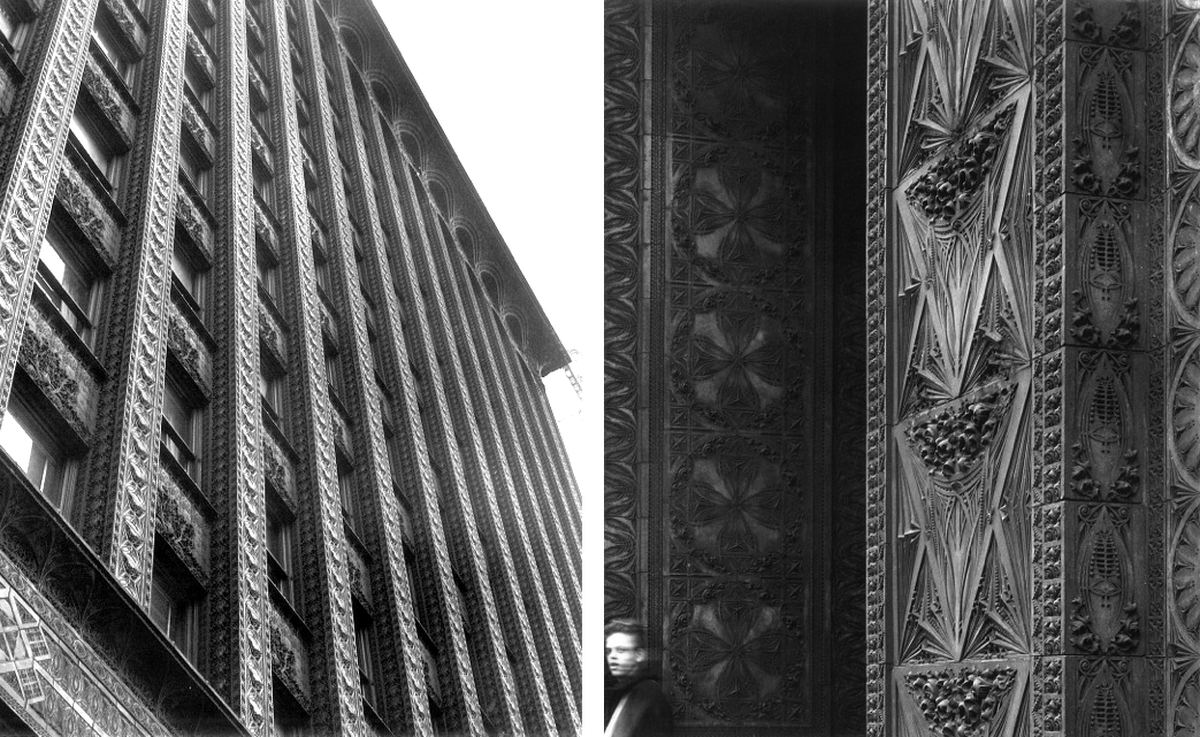
It is here I believe that the architecture of Louis Sullivan offers a counterpoint to the stoicism of the modern movement. Sullivan’s response to the modernist doctrine was not to abandon ornament but to heed the advice of Owen Jones and devise a new and contemporary ornamental vocabulary. The Guaranty Building represents the high point of Sullivan’s communicative architecture. The building presents a veiled ornamental screen of rich terracotta tiles which act to delineate the tripartite composition of the facades. The ornament at the base of the building reflects the connections of its veiled steel structure which support the vertical mullions above. The repetitive program on the upper floors are articulated by a rigid pattern of piers and ornate spandrels. Sullivan completes the composition by employing a concave cornice which absorbs the vertical mullions and acts to complete a flowing continuous organic architecture.
‘Our buildings thus clad in a garment of poetic imagery… will appeal with redoubled power, like a sonorous melody overlaid with harmonious voices’[1] . Although Sullivan never acknowledged the influence of Semper, the Garment analogy used by Sullivan is a clear reference to Semper’s theory of dressing and his insistence that the ‘archetypal origin of built form was textile production’[2]. It is also indicative of the ‘strong influence that German culture had on Chicago in the 19th century’[3].
Ornament was for Sullivan and Semper a demonstration of essential artistic and social motives, ‘being fundamental, the wreath was not only initial, it was also profoundly significant because it manifested the unity of the social body, the people themselves’ [4.
Sullivan’s Architecture represents an alternative modernism where function and ornament were not considered to be in opposition but could coexist to create a symbolic architecture which sought to communicate.
[1] Louis H Sullivan, Kindergarten Chats, Dover Publications Inc, 1980
[2] Kenneth Frampton, Studies in Tectonic Culture, The MIT Press, 1995
[3] Ibid.
[4] David Leatherbarrow, The Roots of Architectural Invention, Cambridge University Press, 1993
Images from John Szarkowski – ‘the idea of Louis Sullivan’ Thames & Hudson, 2000
Joseph Mackey holds a BArch degree from University College Dublin. Joseph won an Architecture Association of Ireland Student Award in 2006 and the Arup Architecture Graduates Medal in 2010. Between 2006 and 2012 he worked with the Renzo Piano Building Workshop in Paris, Tom dePaor in Dublin and Eric Parry Architects in London. Since joining Niall McLaughlin Architects in 2012 he has been working on a chapel for monks in Dublin, the repair and extension of the old Radcliffe Infirmary Outpatients Building in Oxford and the T1 Building for Argent in King’s Cross, London. The T1 Building is a large mixed use development containing a district energy centre, an indoor sports pitch, car parking, shops, bars and 80 apartments.