NMLA Announced as Winners for The Museum of Jesus’ Baptism Competition
February 2026
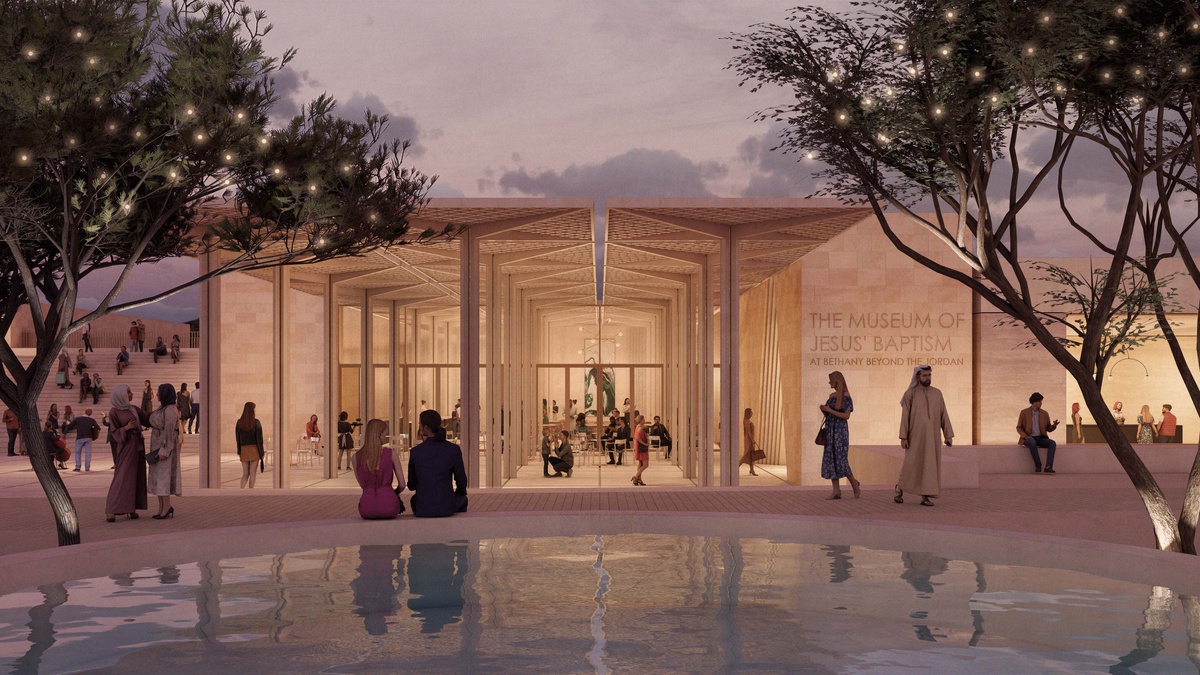
We are delighted that our practice has been announced as the winner of the Malcolm Reading Consultants international competition The Museum of Jesus’ Baptism at Bethany, Jordan.
Our winning concept impressed the Foundation and the Advisory Panel with “its flair for multi-layered and immersive storytelling that focuses on communicating baptism’s power to offer spiritual renewal and new life.” In scale and form, the proposal answered the brief’s call for a museum that ‘evokes wonder and humility in the visitor and responds sensitively to the site’.
Dr Tharwat Almasalha, Chair of the competition’s Advisory Panel and Chair of the Foundation’s Board, said:
‘We congratulate Níall McLaughlin’s team on their proposal which excels in telling the story of baptism – highlighting its power to offer spiritual renewal and new life.
‘We look forward to celebrating the bimillennial of Christ’s baptism in 2030 with the opening of the new museum which promises to be an inspiration for Jordan, faith communities, and secular visitors worldwide.
‘This proposal responds sensitively to the luminous setting in the wilderness and the adjacent UNESCO site. Though modest in size and form, the design has exceptional resonance: it will be attuned to human and divine connections.
‘Together with the NMLA-led team we’re determined to create a museum that will be a global exemplar and acclaimed as a universal symbol of peace.’
The team commented “We are delighted to receive the news that we are the winners of the competition for the Museum of Jesus’ Baptism at Bethany, Jordan. It is an extraordinary site with a profound history. The brief was beautifully written, and the shortlist was exceptionally strong. We felt honored to be chosen to participate with such an interesting group.
‘The challenge of the design was to find a way to allow the architecture to mediate between a charged landscape and the sacred narratives that arose within it. It demanded a building that could work with allegory. At the same time, the project needed to use local labor, skills, and resources to achieve something with a sense of social responsibility and low carbon expenditure. We now look forward to working with the Foundation to develop the design in dialogue with enthusiastic local and international experts. We relish the opportunity to learn more about this beautiful country.’
Our team is supported by Engicon (Local Consultant); Kim Wilkie Landscape (Landscape Architecture); Nissen Richards Studio (Exhibition Design & Wayfinding); Studio ZNA (Lighting Design); and Arup (Daylight & Shadow Studies).
Assyrian Carpet
March 2014
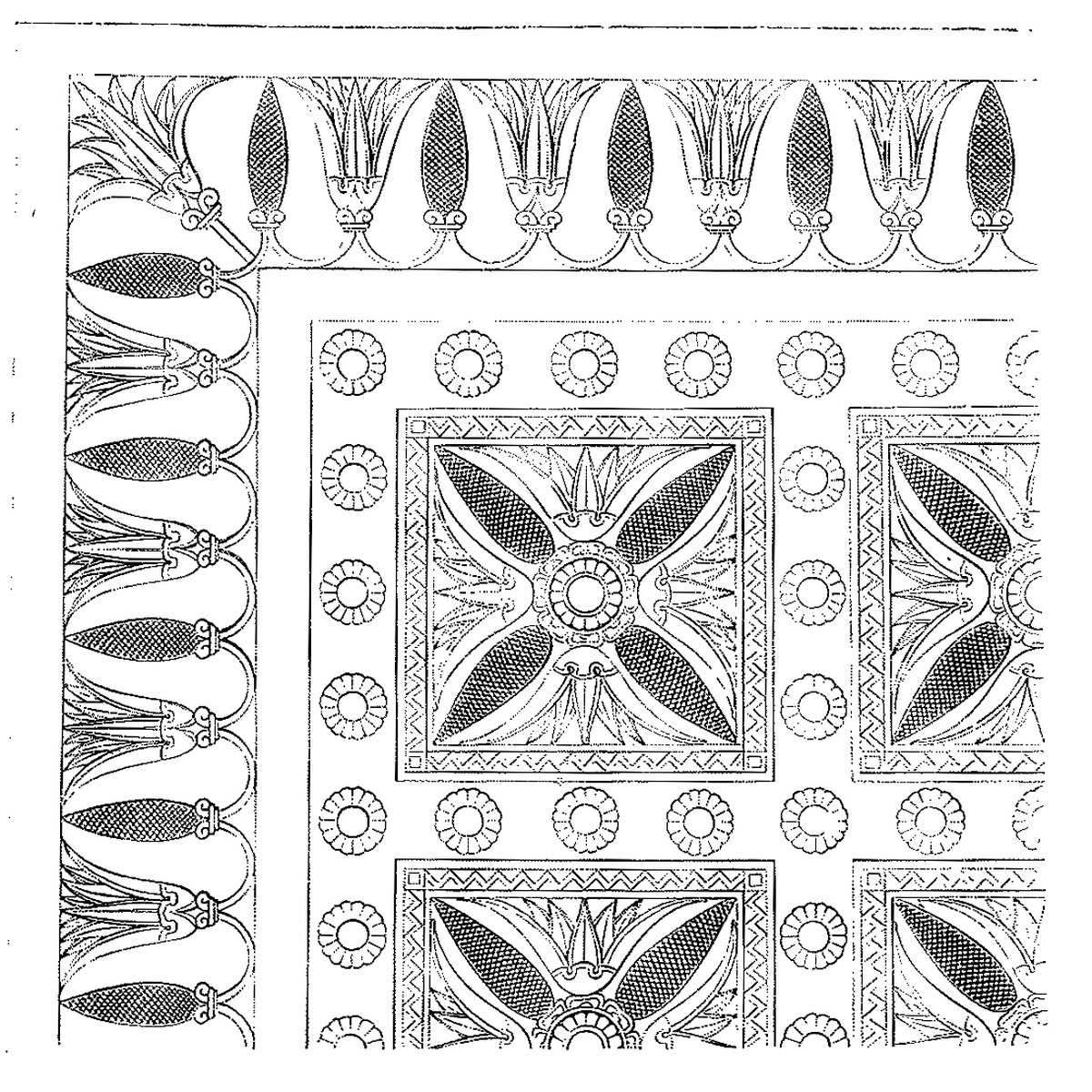
At the Assyrian collection at the British Museum, set amongst the colossal gateways of winged beasts with human heads and resplendent reliefs of bloody scenes from lion hunts, there is a large gypsum alabaster stone panel that was once a decoratively carved and painted door sill made up of inter-weaving patterns and borders, in imitation of a magnificent carpet.
Now wall-mounted in its current home, its intricacies can be clearly admired. Alabaster was discovered by the Assyrians circa 879BC to be ideal for carving fine ornament detail, and huge pieces were accordingly quarried, transported and installed as panels in the internal rooms of royal palaces where reliefs or pattern befitting a king would be carved with an astonishing level of skill within a surface depth of 10-15mm.
For Niall McLaughlin Architects T1 project, carried out for Argent on the King’s Cross redevelopment site, a motif from this ancient panel is being incorporated, along with other patterns from ancient Egypt to the twentieth century, into a number of repeating pre-cast elements that will form the building’s decorative facades and bring this enigmatic piece of deracinated design a new lease of life.
We are currently working towards achieving this in a collaboration with the client and the project’s contractor and a team of architectural pre-cast specialists. After carefully interpreting the motif and integrating it into the facade scheme; the proposed design is now being taken forward by mould makers who are utilising 3D routers to form prototypes of a pattern mould. The first results, which are being awaited with no little anticipation by the design team, will be analysed and the depth and colour of the reliefs carefully calibrated. Within a short period of time the small extract of pattern from an Assyrian carpet in existence nearly three thousand years ago will have a physical presence as part of a tapestry of other pre-cast components on this distinctive building forming, part of this ambitious development in the centre of London.
Image of Assyrian carpet pattern engraved in stone from Gottfried Semper Style in the Technical and Tectonic Arts; or, Practical Aesthetics, Getty Publications, 2004
Tim Burton studied architecture at London Metropolitan University and the ETH Zürich after a previous degree in Fine Art and Art History at Goldsmith’s College and experience within the film industry. He has also worked for Gramazio and Kohler’s Research Chair for Architecture and Digital Fabrication. Tim joined Niall McLaughlin Architects in 2012. Since joining the practice, he has worked on a Peabody housing project in Whitechapel and the T1 Building for Argent in London’s Kings Cross. The T1 Building is a large mixed use development containing a district energy centre, an indoor sports pitch, car parking, shops, bars and 80 apartments.