NMLA Announced as Winners for The Museum of Jesus’ Baptism Competition
February 2026
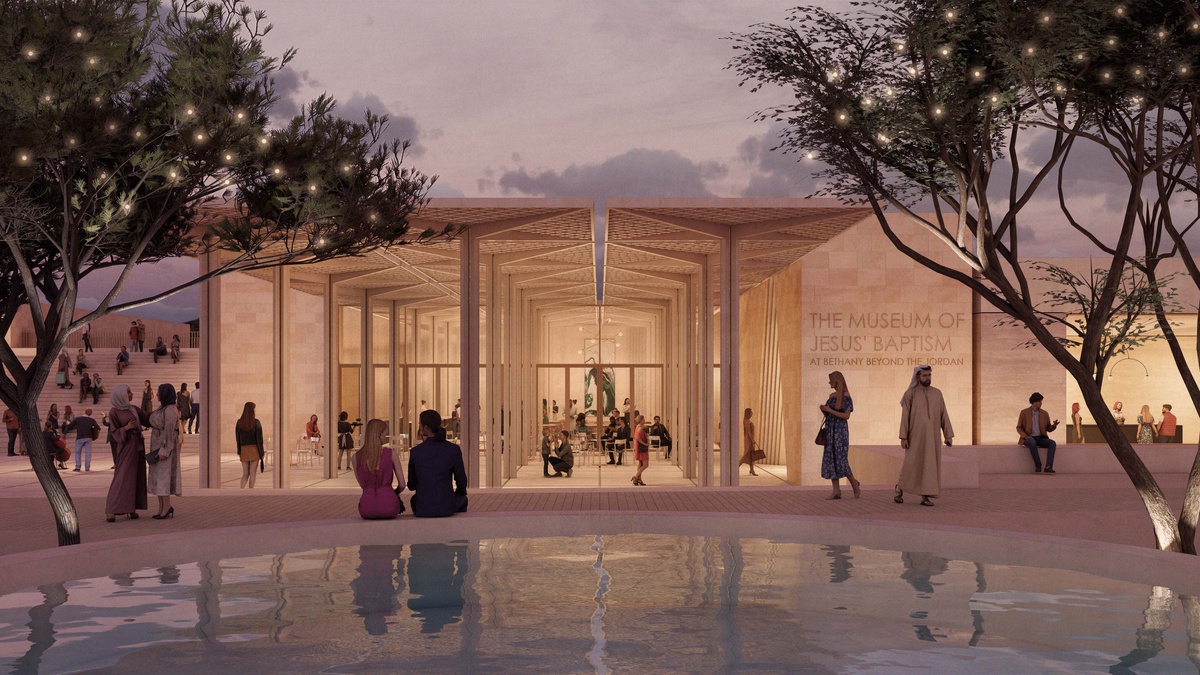
We are delighted that our practice has been announced as the winner of the Malcolm Reading Consultants international competition The Museum of Jesus’ Baptism at Bethany, Jordan.
Our winning concept impressed the Foundation and the Advisory Panel with “its flair for multi-layered and immersive storytelling that focuses on communicating baptism’s power to offer spiritual renewal and new life.” In scale and form, the proposal answered the brief’s call for a museum that ‘evokes wonder and humility in the visitor and responds sensitively to the site’.
Dr Tharwat Almasalha, Chair of the competition’s Advisory Panel and Chair of the Foundation’s Board, said:
‘We congratulate Níall McLaughlin’s team on their proposal which excels in telling the story of baptism – highlighting its power to offer spiritual renewal and new life.
‘We look forward to celebrating the bimillennial of Christ’s baptism in 2030 with the opening of the new museum which promises to be an inspiration for Jordan, faith communities, and secular visitors worldwide.
‘This proposal responds sensitively to the luminous setting in the wilderness and the adjacent UNESCO site. Though modest in size and form, the design has exceptional resonance: it will be attuned to human and divine connections.
‘Together with the NMLA-led team we’re determined to create a museum that will be a global exemplar and acclaimed as a universal symbol of peace.’
The team commented “We are delighted to receive the news that we are the winners of the competition for the Museum of Jesus’ Baptism at Bethany, Jordan. It is an extraordinary site with a profound history. The brief was beautifully written, and the shortlist was exceptionally strong. We felt honored to be chosen to participate with such an interesting group.
‘The challenge of the design was to find a way to allow the architecture to mediate between a charged landscape and the sacred narratives that arose within it. It demanded a building that could work with allegory. At the same time, the project needed to use local labor, skills, and resources to achieve something with a sense of social responsibility and low carbon expenditure. We now look forward to working with the Foundation to develop the design in dialogue with enthusiastic local and international experts. We relish the opportunity to learn more about this beautiful country.’
Our team is supported by Engicon (Local Consultant); Kim Wilkie Landscape (Landscape Architecture); Nissen Richards Studio (Exhibition Design & Wayfinding); Studio ZNA (Lighting Design); and Arup (Daylight & Shadow Studies).
FIAT-MIRAFIORI
November 2014
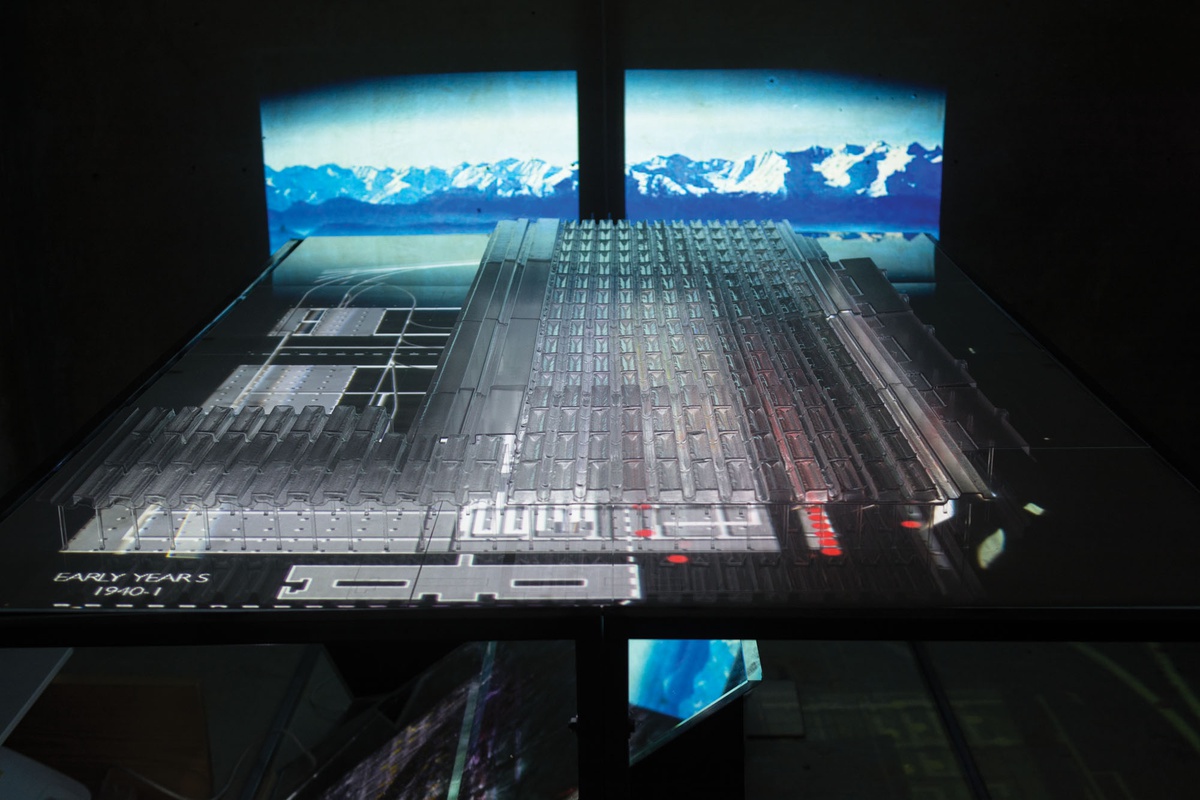
FIAT-MIRAFIORI, Turin, Italy
Located in a suburb of post-industrial Turin, once the ‘Fordist world’s most prototypical town’, the proposal is for a campus university sited within the endless 20m x 20m concrete grid of Fiat’s behemoth Mirafiori plant (1939). The proposed high-speed railway link between Lyon, Turin and Budapest is seen as a driving agent in re-establishing the city and its traditional expertise in manufacturing within a wider European context. The project is an exploration of the open-plan, balancing the generic with the particular by interweaving new programmes and functions into the repetitive matrix of the existing concrete frame.
The design focuses on the sectional distribution of the master plan, with workshops, offices, lecture theatres and public squares at ground level, and housing, communal facilities, nursery schools and shared gardens inhabiting the building’s roof. Occupying a site equivalent in area to Turin’s historic centre, the project envisages Mirafiori as a new city quarter articulated by the shifting presence of production, research, commerce and living.
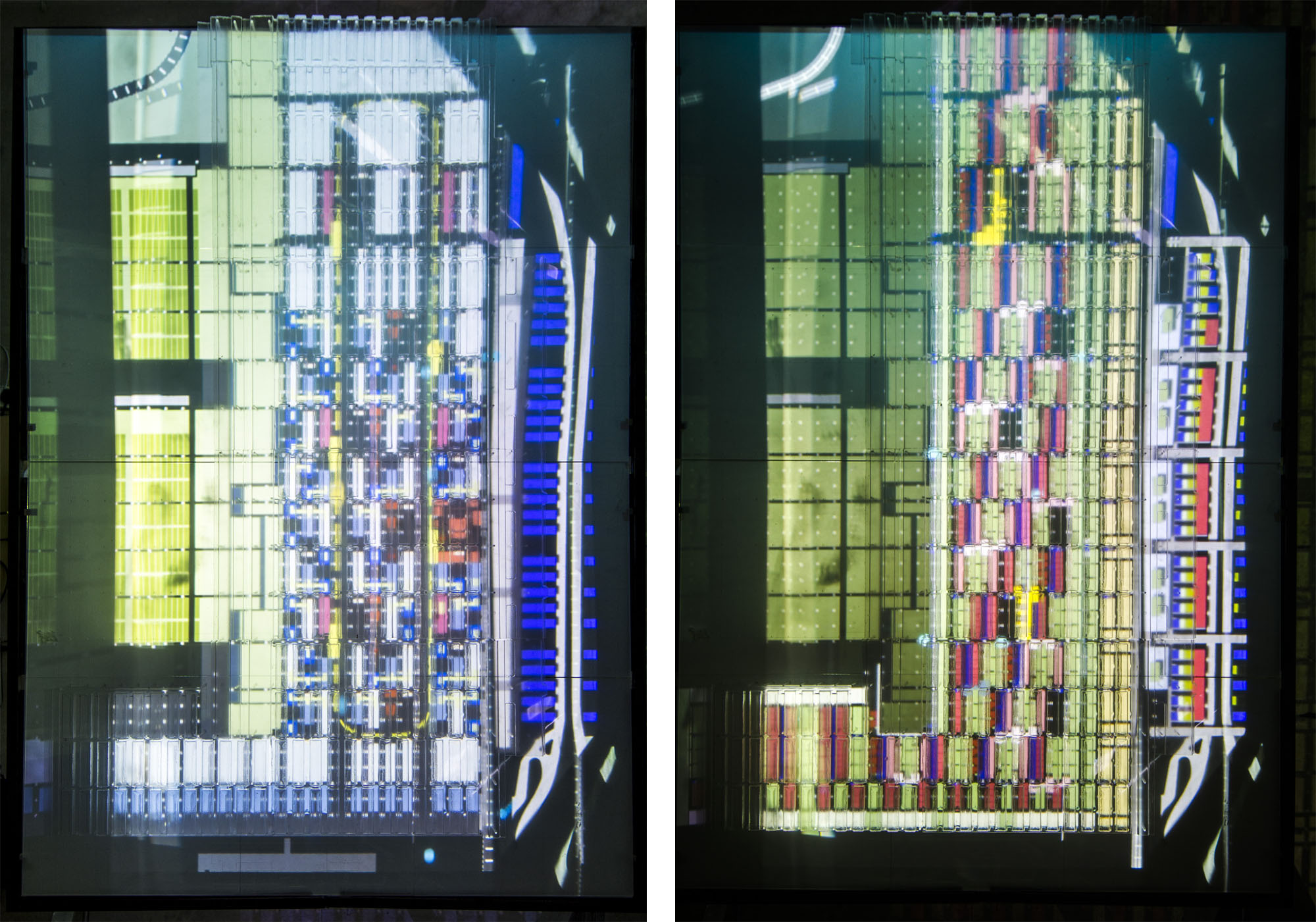
The images above depict an installation built as a 1:500 representation of the site. Conceived as a simple armature, the model afforded a large-scale, neutral, three-dimensional surface that momentarily held the light and colour cast by a moving, digital projection. I was interested in how this plain surface could take the role of both narrative device, upon which the dynamic history of the building’s conception, construction and early operation could be retraced and re-recorded, and serve as a framework within which to test differing scenarios for the site’s re-inhabitation.
Reflecting on the experience of making this installation, I have now come to realise that what had started out as process of historic site analysis, drawn to scale and illustrated through light, had become (quite unintentionally) suggestive of a proposed architecture. Experienced at 1:1, the installation produced a dreamy environment of diaphanous surfaces, coloured light and whirring sound. Whilst the subject and intent of the installation was still historical, it no longer just retold but ‘produced’ a shifting architecture, temporary in nature and formed through the lightest touch of light, colour, diffraction and shadow. Exploring this disjunction between intent and outcome a bit further, I can now recognise that through the initial planning, fabrication and composition, activities that at the time I only understood as a means to an end, I had already made a series of decisions about the installation’s form, scale and materiality. The subsequent processes of animation, projection, filming and finally editing footage and sound together, added further faculties of decision, critique, editorship and importantly chance or accident. Each, in turn, contributed an iteration – an opportunity to reflect, develop and transform – which, slowly but surely, transformed a representation of the past into a proposal for the future.
Alastair Browning is a member of the Auckland Castle team at Niall McLaughlin Architects. His thesis project FIAT-Mirafiori, undertaken whilst studying with Unit 17 at the Bartlett and tutored by Niall McLaughlin, Yeoryia Manolopoulou and Michiko Sumi, has been selected as one of 11 highly-achieving postgraduate projects from across London’s architecture schools to exhibit at the Architecture Foundation’s Futures in the Making Exhibition.
Futures in the Making is being held at Feilden Clegg Bradley Studios, Twenty Tottenham Street, London W1T 4RF ( Until the 28th November 1.45 – 6pm)