NMLA Announced as Winners for The Museum of Jesus’ Baptism Competition
February 2026
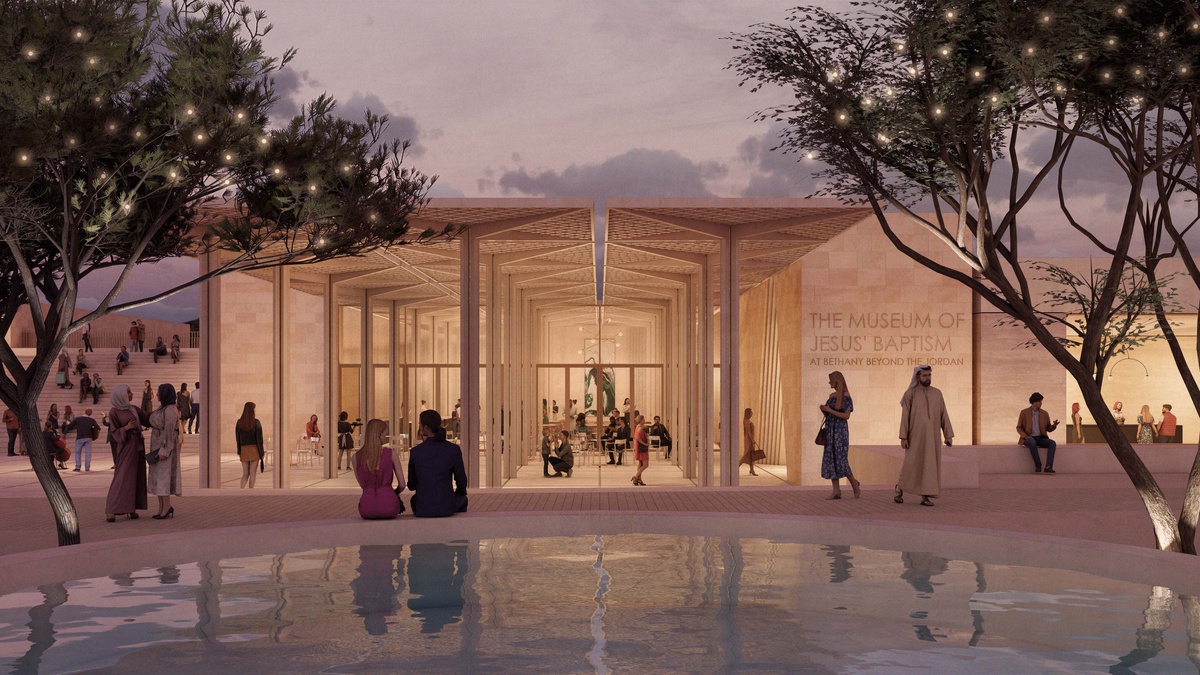
We are delighted that our practice has been announced as the winner of the Malcolm Reading Consultants international competition The Museum of Jesus’ Baptism at Bethany, Jordan.
Our winning concept impressed the Foundation and the Advisory Panel with “its flair for multi-layered and immersive storytelling that focuses on communicating baptism’s power to offer spiritual renewal and new life.” In scale and form, the proposal answered the brief’s call for a museum that ‘evokes wonder and humility in the visitor and responds sensitively to the site’.
Dr Tharwat Almasalha, Chair of the competition’s Advisory Panel and Chair of the Foundation’s Board, said:
‘We congratulate Níall McLaughlin’s team on their proposal which excels in telling the story of baptism – highlighting its power to offer spiritual renewal and new life.
‘We look forward to celebrating the bimillennial of Christ’s baptism in 2030 with the opening of the new museum which promises to be an inspiration for Jordan, faith communities, and secular visitors worldwide.
‘This proposal responds sensitively to the luminous setting in the wilderness and the adjacent UNESCO site. Though modest in size and form, the design has exceptional resonance: it will be attuned to human and divine connections.
‘Together with the NMLA-led team we’re determined to create a museum that will be a global exemplar and acclaimed as a universal symbol of peace.’
The team commented “We are delighted to receive the news that we are the winners of the competition for the Museum of Jesus’ Baptism at Bethany, Jordan. It is an extraordinary site with a profound history. The brief was beautifully written, and the shortlist was exceptionally strong. We felt honored to be chosen to participate with such an interesting group.
‘The challenge of the design was to find a way to allow the architecture to mediate between a charged landscape and the sacred narratives that arose within it. It demanded a building that could work with allegory. At the same time, the project needed to use local labor, skills, and resources to achieve something with a sense of social responsibility and low carbon expenditure. We now look forward to working with the Foundation to develop the design in dialogue with enthusiastic local and international experts. We relish the opportunity to learn more about this beautiful country.’
Our team is supported by Engicon (Local Consultant); Kim Wilkie Landscape (Landscape Architecture); Nissen Richards Studio (Exhibition Design & Wayfinding); Studio ZNA (Lighting Design); and Arup (Daylight & Shadow Studies).