NMLA Announced as Winners for The Museum of Jesus’ Baptism Competition
February 2026
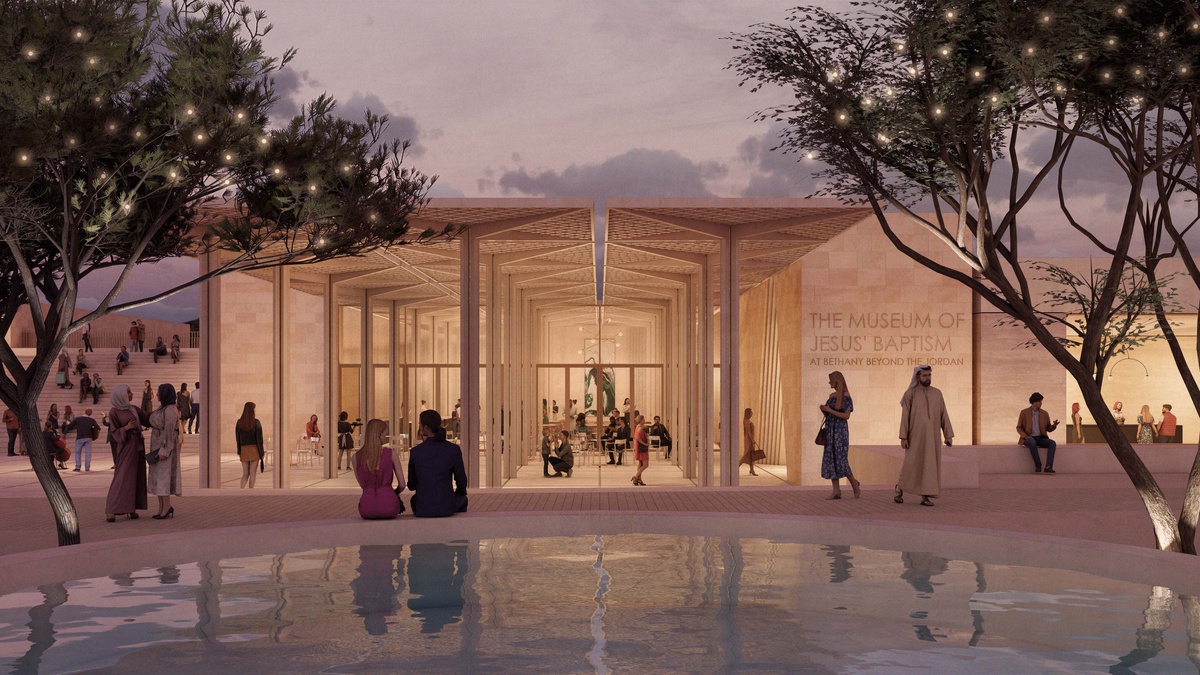
We are delighted that our practice has been announced as the winner of the Malcolm Reading Consultants international competition The Museum of Jesus’ Baptism at Bethany, Jordan.
Our winning concept impressed the Foundation and the Advisory Panel with “its flair for multi-layered and immersive storytelling that focuses on communicating baptism’s power to offer spiritual renewal and new life.” In scale and form, the proposal answered the brief’s call for a museum that ‘evokes wonder and humility in the visitor and responds sensitively to the site’.
Dr Tharwat Almasalha, Chair of the competition’s Advisory Panel and Chair of the Foundation’s Board, said:
‘We congratulate Níall McLaughlin’s team on their proposal which excels in telling the story of baptism – highlighting its power to offer spiritual renewal and new life.
‘We look forward to celebrating the bimillennial of Christ’s baptism in 2030 with the opening of the new museum which promises to be an inspiration for Jordan, faith communities, and secular visitors worldwide.
‘This proposal responds sensitively to the luminous setting in the wilderness and the adjacent UNESCO site. Though modest in size and form, the design has exceptional resonance: it will be attuned to human and divine connections.
‘Together with the NMLA-led team we’re determined to create a museum that will be a global exemplar and acclaimed as a universal symbol of peace.’
The team commented “We are delighted to receive the news that we are the winners of the competition for the Museum of Jesus’ Baptism at Bethany, Jordan. It is an extraordinary site with a profound history. The brief was beautifully written, and the shortlist was exceptionally strong. We felt honored to be chosen to participate with such an interesting group.
‘The challenge of the design was to find a way to allow the architecture to mediate between a charged landscape and the sacred narratives that arose within it. It demanded a building that could work with allegory. At the same time, the project needed to use local labor, skills, and resources to achieve something with a sense of social responsibility and low carbon expenditure. We now look forward to working with the Foundation to develop the design in dialogue with enthusiastic local and international experts. We relish the opportunity to learn more about this beautiful country.’
Our team is supported by Engicon (Local Consultant); Kim Wilkie Landscape (Landscape Architecture); Nissen Richards Studio (Exhibition Design & Wayfinding); Studio ZNA (Lighting Design); and Arup (Daylight & Shadow Studies).
From Workshop to Site
September 2020
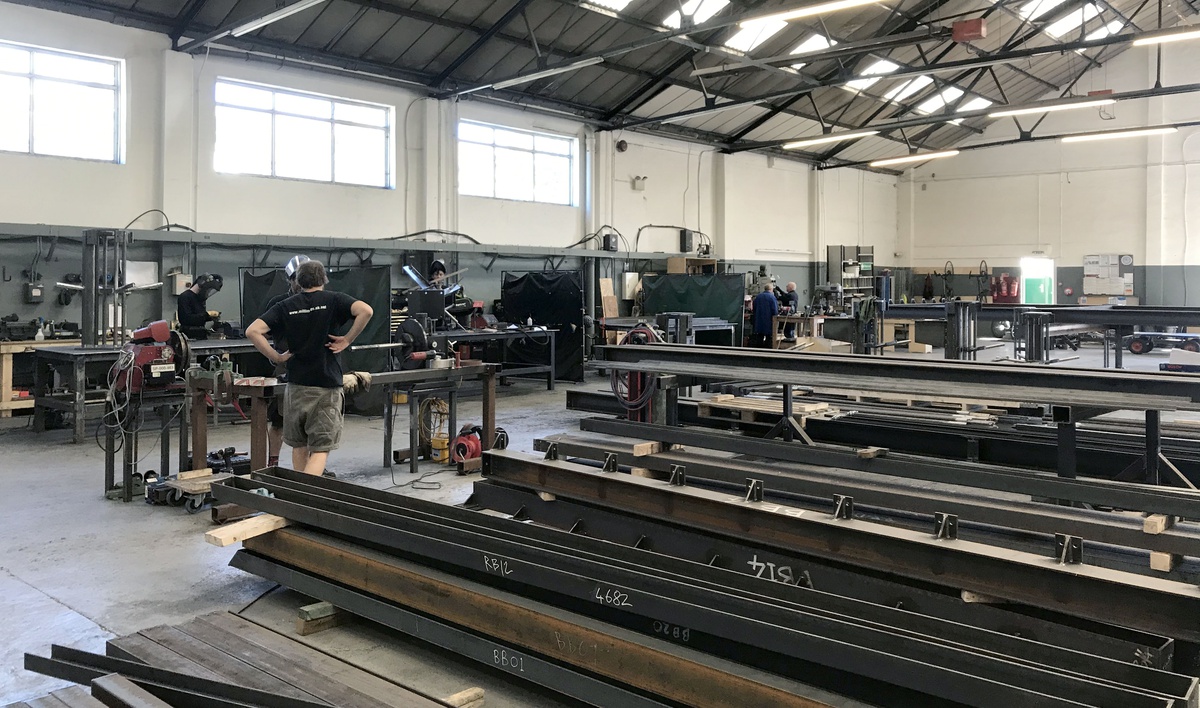
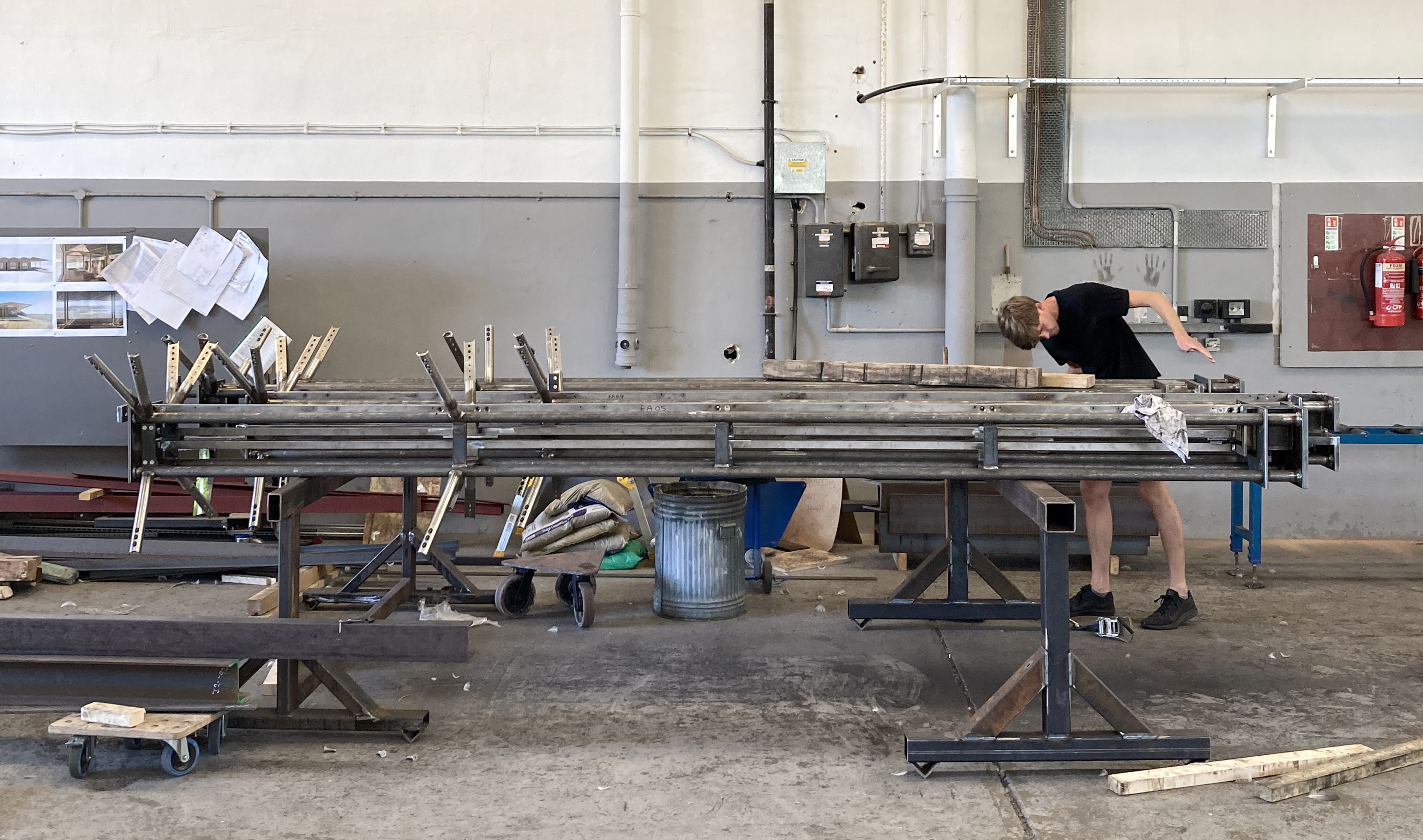
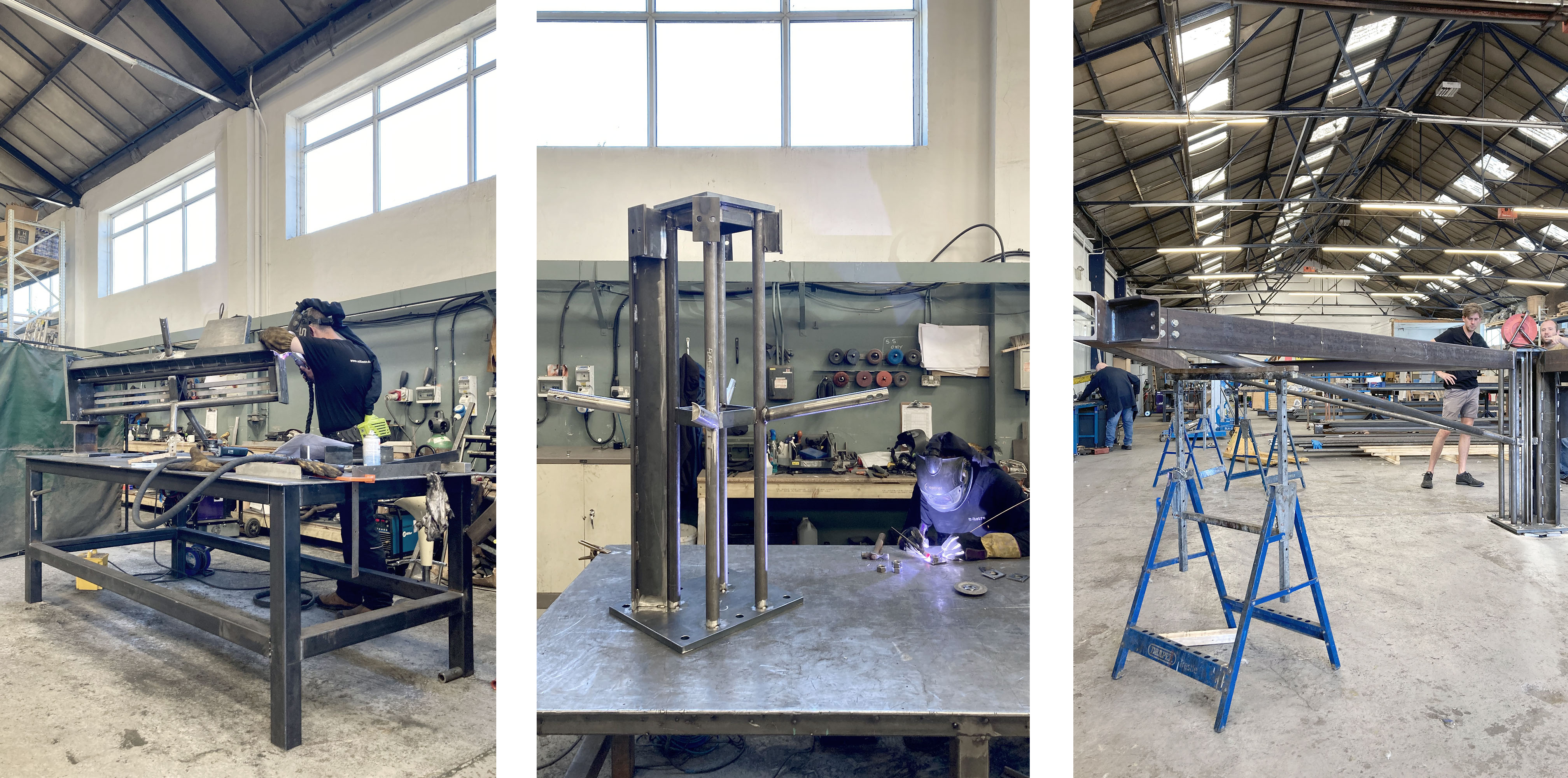
At Millimetre’s workshop in Brighton, a tremendous steel skeleton has been rapidly emerging. It will form the delicate superstructure of a garden pavilion-cum-guesthouse destined for the Isle of Wight. In the main hangar, a healthy collection of gently oxidizing off-the-shelf steel sections and staggeringly sharp, bespoke milled elements is set back from a row of socially-distanced workspaces. Millimetre’s metal workers have been working around the clock (and in the excessive summer heat) to cut, weld and grind the heap in front of them into the many precise modular components that will form the pavilion’s columns, floor and roof. An assembly line has been formed to increase the efficiency of fabrication, with a station each for repetitive rotary welding tasks, rotary grinding, welding using custom jigs and more complicated non-linear welds. As the steel passes through the workshop, glistening segments come to form elaborate sculptures. Adjacent to the metalworking bays is a six-axis robot arm programmed to cut high density foam into jigs for the most intricate welding alignments. This will be essential to the success of the central roof truss node, where nine tubular sections converge. More on this will follow at a later date.
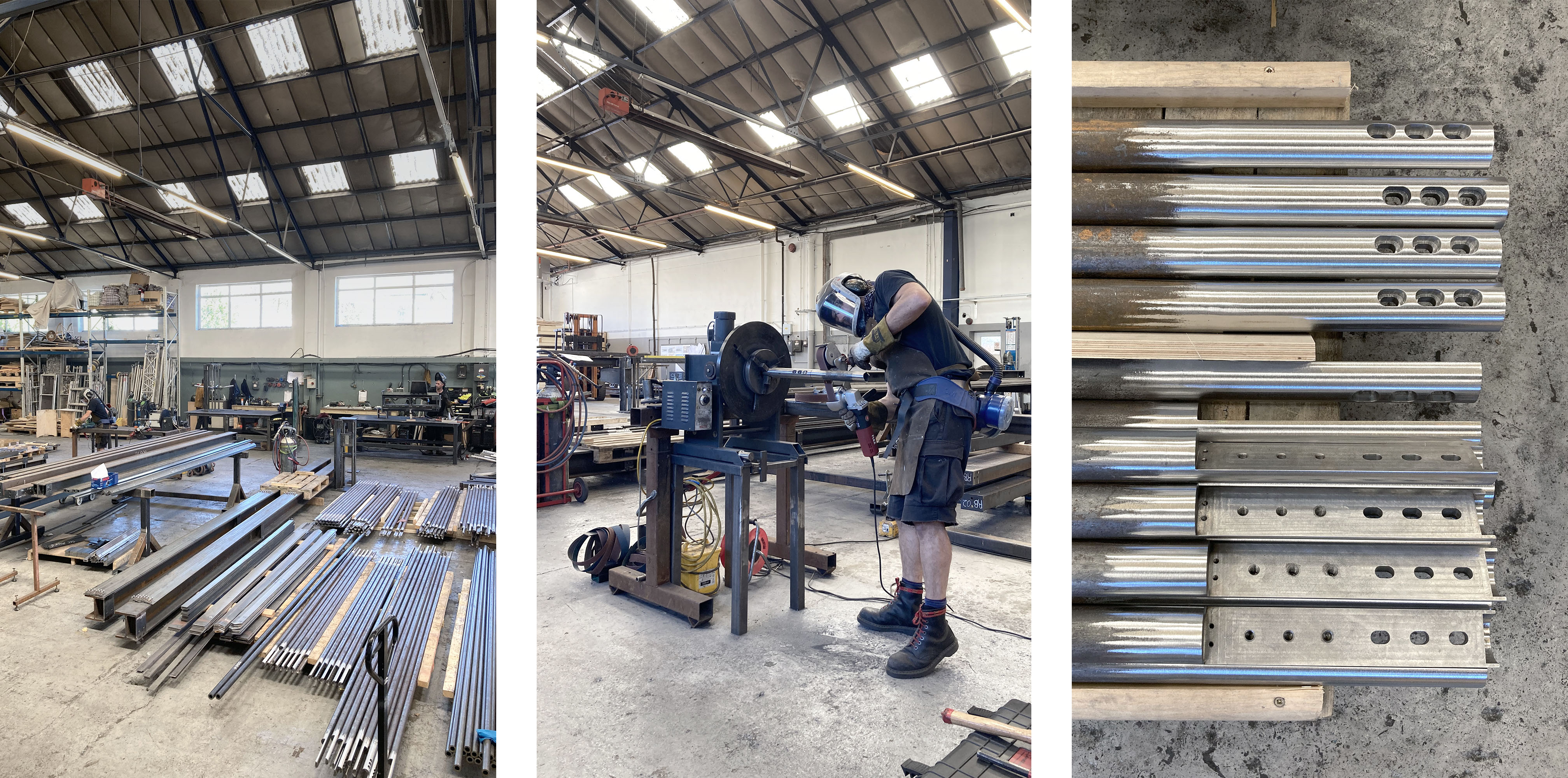
The pavilion will be lifted off the ground by cantilevering trusses held from the main columns, which are formed of four tubular sections tied together by intermittent thin plates along their height. The lower portions of these columns, which sit beneath the floor build-up, are amicably referred to as the daleks. These stub columns are the first pieces to be finalized, quickly assembled in tandem to confirm tolerances, and sent away to be painted for corrosion protection before arriving to site.
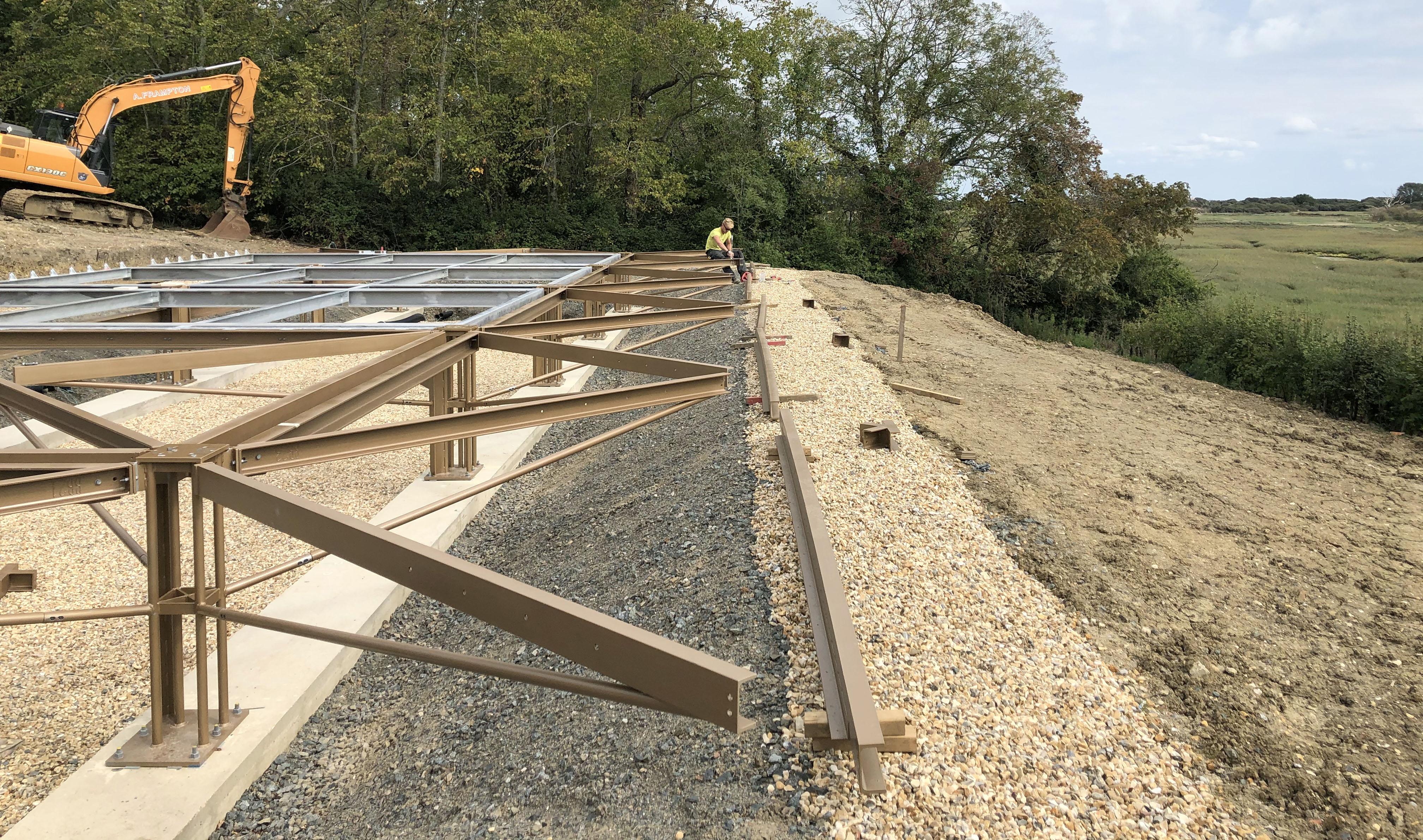
On the northeast coast of the Isle of Wight, the site falls to overlook a protected marshland with tidal flows fed by the Solent. A shallow depression with raking banks at the bottom of the hill will conceal the feet of the pavilion superstructure; the baseplates of the stub columns now erected atop the long strip foundations and adjoined to form the triangulated support for the floor and deck above. Located to capture rainwater dropping from the overhanging roof eaves, the perimeter gravel drain will also mark the boundary between building and landscape, with tall, wild grasses merging with the wetland beyond..
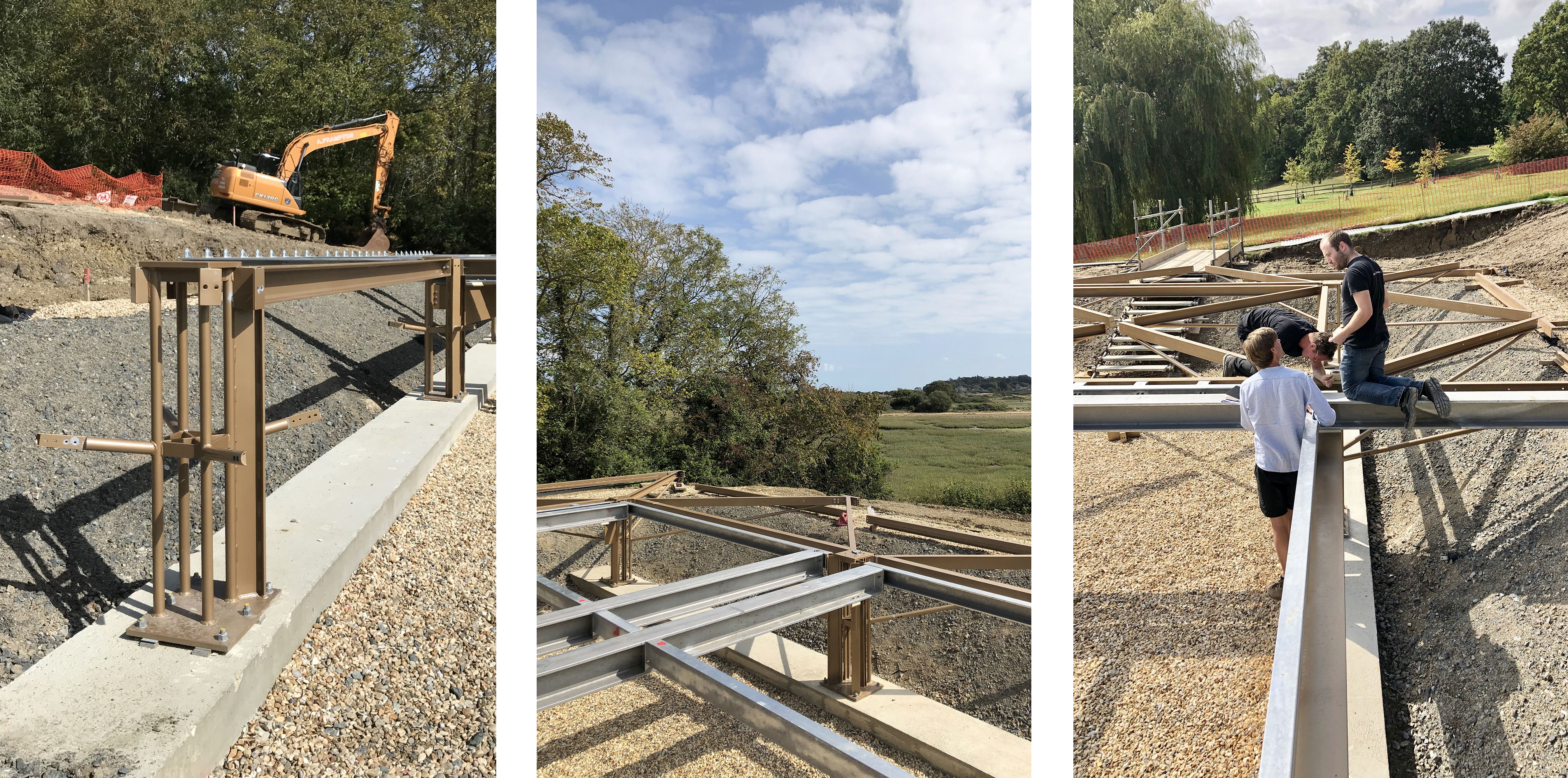
As the pavilion envelope will be formed largely of full-width glass spans closely abutting the columns, erecting the steel frame precisely is critical. Despite a remarkable installation tolerance of +/- 3mm diagonally across each 5 x 5m bay, the stub columns must be shimmed to ensure exact alignment and verticality. Between them, the galvanised (and thus silvery) internal floor beams are distinguishable from the external floor beams, which are coated to resist corrosion and painted to achieve a warm metallic finish. With the cantilevering terrace beams installed additionally, a datum is formed approximately 180mm below the intended finished floor level from which the remainder of the pavilion will rise..
Back in Brighton, the columns which will stand on the shoulders of the stubs now installed on site are laid out one by one. Their height and slenderness astound – a true feat for the structural engineers, Smith & Wallwork. It is through, not around these columns that the thermal envelope will run, with tall and narrow glazing centred on each column between the four vertical tubes. The next test-build will involve hoisting up these columns, narrowly missing the suspended lights of the workshop, to bolt on the roof trusses via the halving joints rigidly reaching out to receive them. That dramatic and exciting update will have to follow.