Resolution to grant planning permission to University College Oxford passed
October 2020
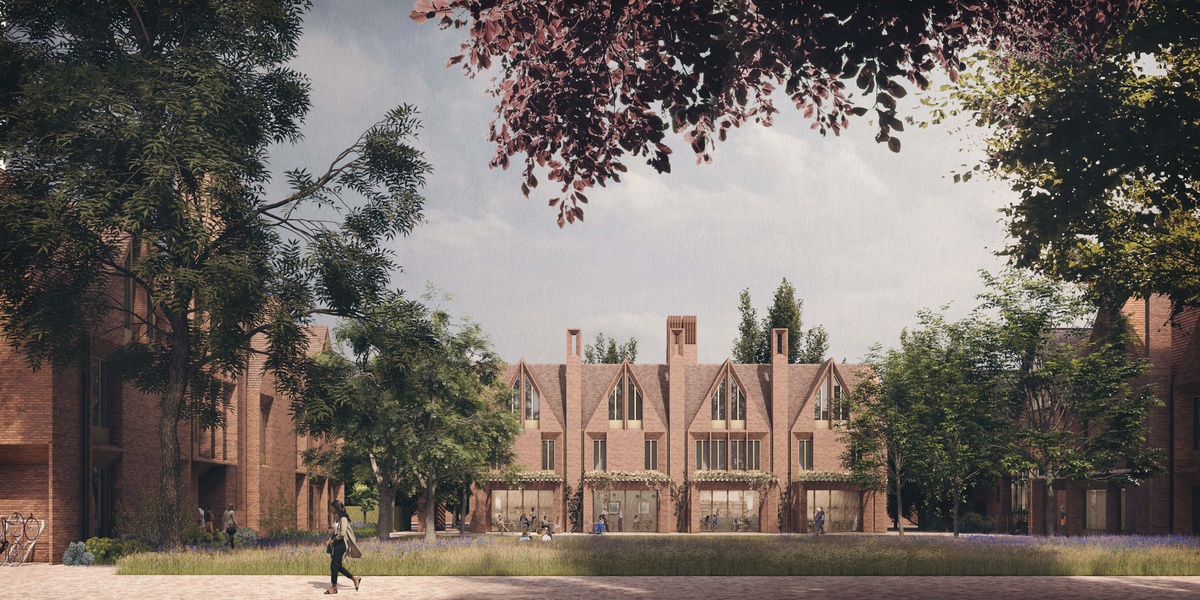
Oxford City Council has passed a resolution to grant planning permission to University College Oxford (‘Univ’) for a new collegiate development in the North Oxford Victorian Suburb Conservation Area (NOVSCA). The scheme is for 150 new student bedrooms and represents the largest addition to the College in over three centuries. Niall McLaughlin Architects and Kim Wilkie won the commission in 2018 following an architectural competition.
The development – Univ North – will complement Univ’s High Street site in the city centre, and will enrich the College’s existing satellite annexe in north Oxford. Designed as an extensive, landscape-led proposal, the development will provide accommodation and facilities to encourage and nurture a multi-generational community. The whole development site embraces an existing care home and proposes new accommodation for undergraduates, postgraduates and early career academics along with a children’s nursery. In addition, the site will house a student café, a gym, ancillary study rooms, and a multipurpose common space for College events to which it is hoped the local community will join.
The scheme has been designed to improve the setting of the existing buildings and specimen trees by removing unsympathetic extensions and planting. Existing and new buildings frame a series of richly planted open, south-facing gardens and courts that are connected by a principal east-west path. The architecture and massing of the new buildings varies across the site as they respond to the immediate context in differing Character Areas that include Victorian and Edwardian villas, and notable modern buildings by Sir Philip Dowson and Geoffrey Beard. Existing and new buildings frame a series of richly planted open, south-facing gardens and courts that are connected by a principal east-west path. The architecture and massing of the new buildings varies across the site as they respond to the immediate context in differing Character Areas that include Victorian and Edwardian villas, and notable modern buildings by Sir Philip Dowson and Geoffrey Beard.
Sir Ivor Crewe, Master of University College at the time, said: “We are delighted that the City Council has supported our proposals for Univ North. It is a very exciting project, which will enable the College to deepen our own accommodation provision and support for future generations of students and academics studying at Univ.”
Assyrian Carpet
March 2014
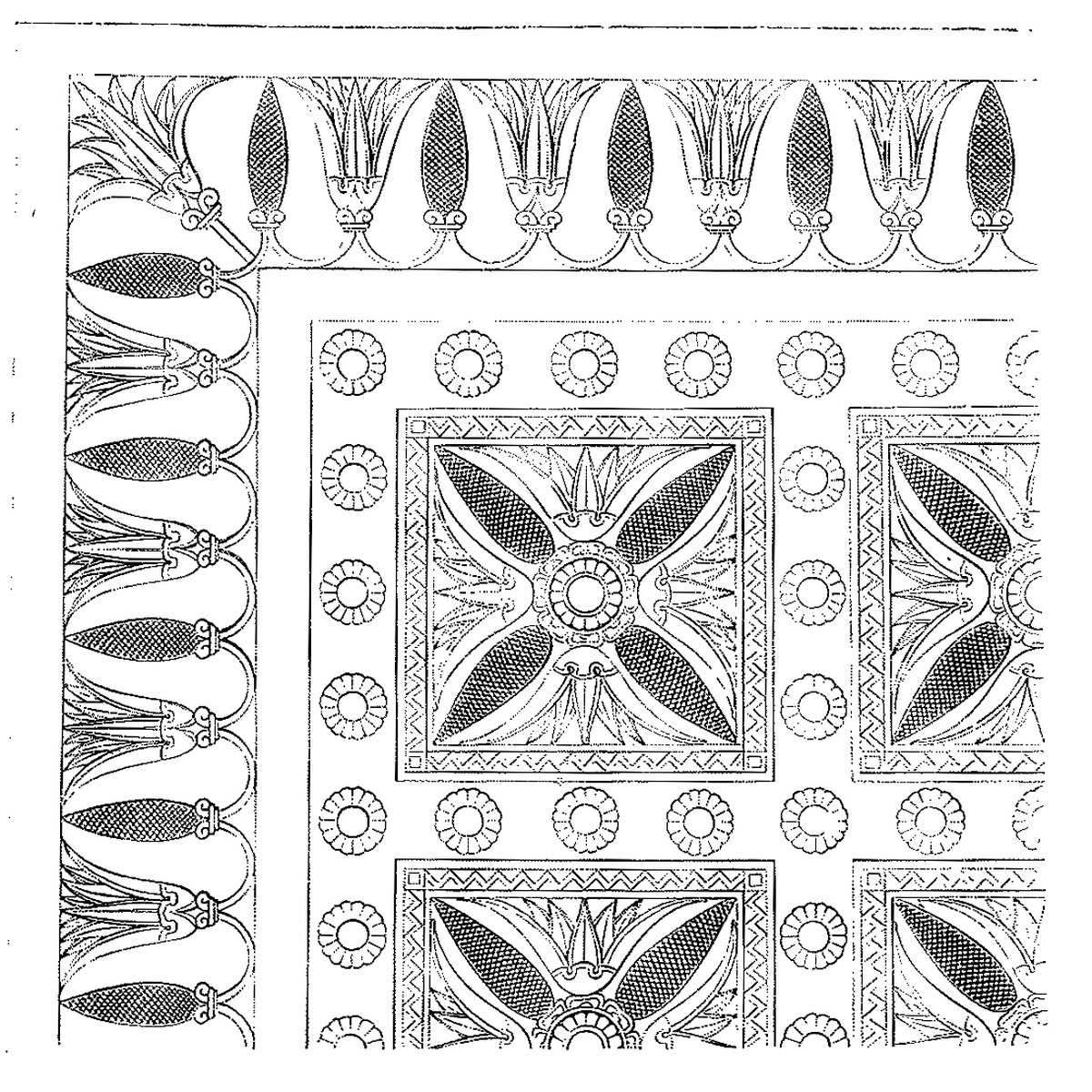
At the Assyrian collection at the British Museum, set amongst the colossal gateways of winged beasts with human heads and resplendent reliefs of bloody scenes from lion hunts, there is a large gypsum alabaster stone panel that was once a decoratively carved and painted door sill made up of inter-weaving patterns and borders, in imitation of a magnificent carpet.
Now wall-mounted in its current home, its intricacies can be clearly admired. Alabaster was discovered by the Assyrians circa 879BC to be ideal for carving fine ornament detail, and huge pieces were accordingly quarried, transported and installed as panels in the internal rooms of royal palaces where reliefs or pattern befitting a king would be carved with an astonishing level of skill within a surface depth of 10-15mm.
For Niall McLaughlin Architects T1 project, carried out for Argent on the King’s Cross redevelopment site, a motif from this ancient panel is being incorporated, along with other patterns from ancient Egypt to the twentieth century, into a number of repeating pre-cast elements that will form the building’s decorative facades and bring this enigmatic piece of deracinated design a new lease of life.
We are currently working towards achieving this in a collaboration with the client and the project’s contractor and a team of architectural pre-cast specialists. After carefully interpreting the motif and integrating it into the facade scheme; the proposed design is now being taken forward by mould makers who are utilising 3D routers to form prototypes of a pattern mould. The first results, which are being awaited with no little anticipation by the design team, will be analysed and the depth and colour of the reliefs carefully calibrated. Within a short period of time the small extract of pattern from an Assyrian carpet in existence nearly three thousand years ago will have a physical presence as part of a tapestry of other pre-cast components on this distinctive building forming, part of this ambitious development in the centre of London.
Image of Assyrian carpet pattern engraved in stone from Gottfried Semper Style in the Technical and Tectonic Arts; or, Practical Aesthetics, Getty Publications, 2004
Tim Burton studied architecture at London Metropolitan University and the ETH Zürich after a previous degree in Fine Art and Art History at Goldsmith’s College and experience within the film industry. He has also worked for Gramazio and Kohler’s Research Chair for Architecture and Digital Fabrication. Tim joined Niall McLaughlin Architects in 2012. Since joining the practice, he has worked on a Peabody housing project in Whitechapel and the T1 Building for Argent in London’s Kings Cross. The T1 Building is a large mixed use development containing a district energy centre, an indoor sports pitch, car parking, shops, bars and 80 apartments.