Níall McLaughlin Receives 2026 Royal Gold Medal for Architecture
January 2026
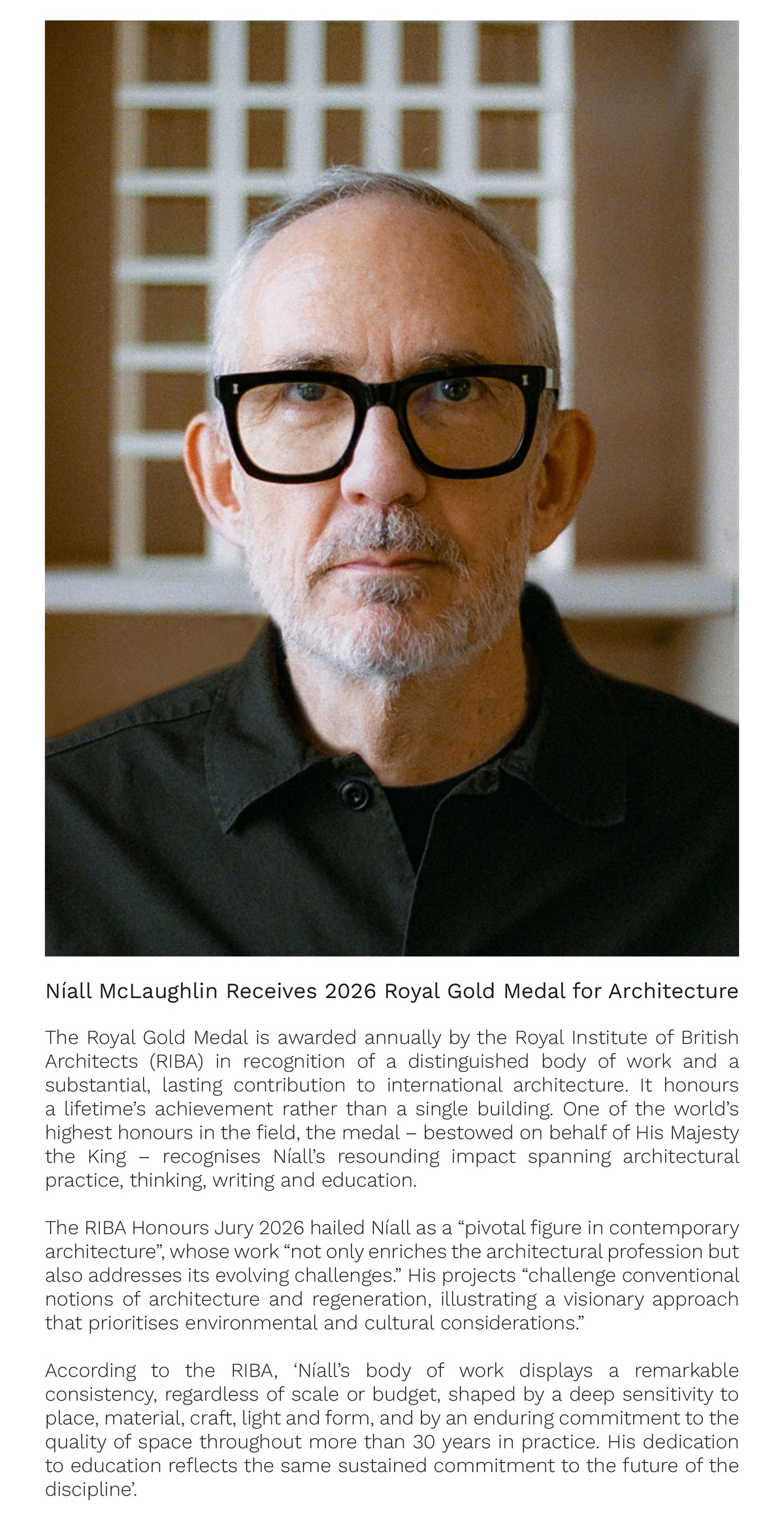
Established in 1990, Níall McLaughlin Architects is a London-based practice designing buildings for education, culture, faith, care, and housing, all grounded in an approach that sees architecture as learning, craft, and ritual that endures through human engagement and collective use.
Acknowledging the award Níall said ‘Architecture is a patient and ethical act, one that unfolds through care for people, places, and institutions, over time. To receive the Royal Gold Medal from a jury so deeply engaged in education, culture, and civic life is an honour that affirms these values. It encourages us to continue working with the same attentiveness, restraint, and responsibility that have shaped our practice from the beginning.’
RIBA President and Chair of the 2026 RIBA Honours Jury, Chris Williamson, said: “Always one to credit and uplift those around him, it is fitting that Níall is recognised for the resounding impact he has had on the profession. As an educator, he has been an outstanding role model for young architects, while his designs - eclectic in appearance and use - share a sense of care and grace that represent the very best of architecture.
Such sustained success has in no way diminished his humility. A humble visionary, his dedication to architecture as an art and professional practice has left an enduring mark on the discipline – one that will undoubtedly transcend trends and time.”
The 2026 RIBA Honours Jury was chaired by RIBA President Chris Williamson and comprised of 2025 Royal Gold Medal recipient Kazuyo Sejima of SANAA, Anna Liu of Tonkin Liu, Isabel Allen, Editor, Architecture Today and Victoria Farrow, Architect and Subject Lead in Architecture and the Built Environment at Leicester School of Architecture, De Montfort University.
Assyrian Carpet
March 2014
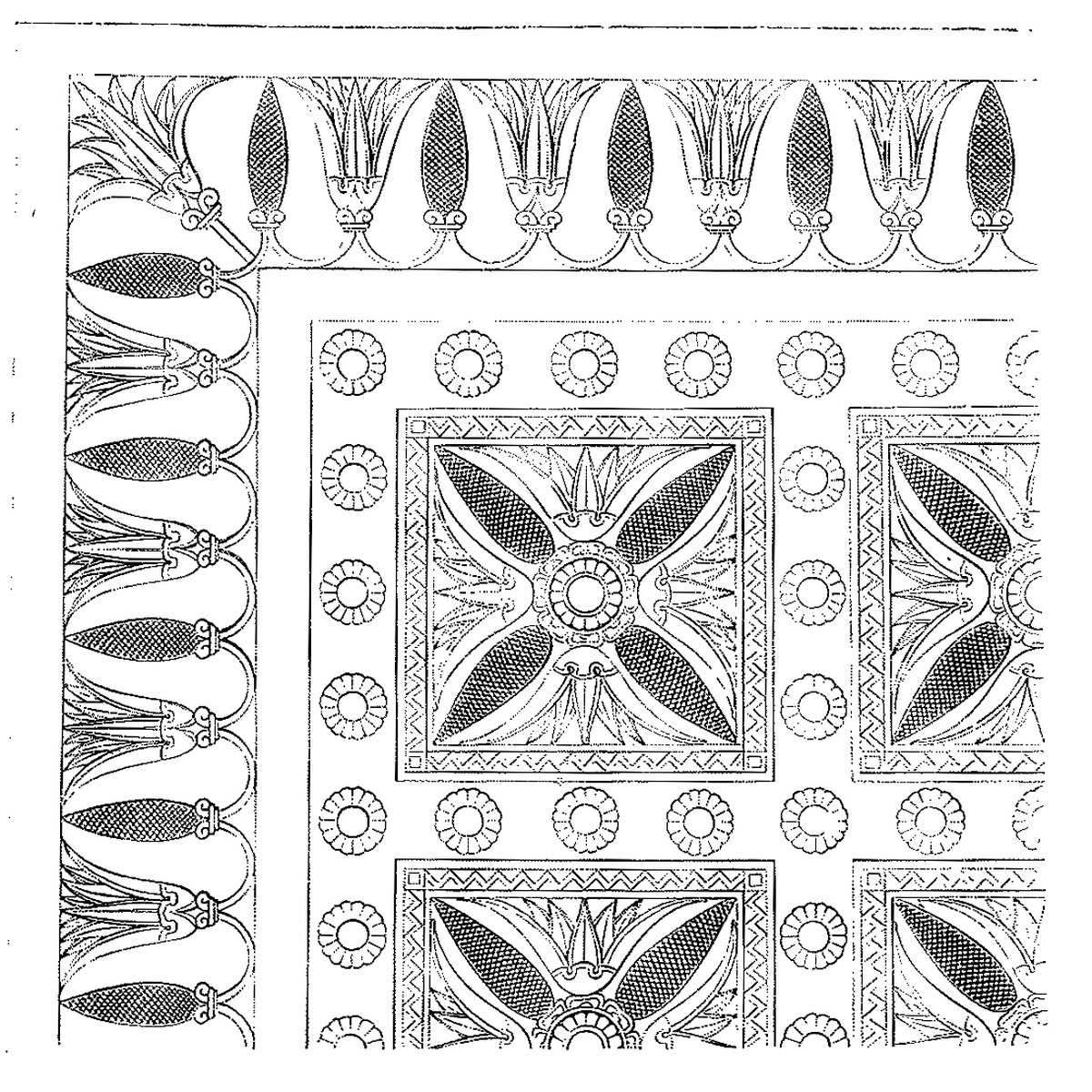
At the Assyrian collection at the British Museum, set amongst the colossal gateways of winged beasts with human heads and resplendent reliefs of bloody scenes from lion hunts, there is a large gypsum alabaster stone panel that was once a decoratively carved and painted door sill made up of inter-weaving patterns and borders, in imitation of a magnificent carpet.
Now wall-mounted in its current home, its intricacies can be clearly admired. Alabaster was discovered by the Assyrians circa 879BC to be ideal for carving fine ornament detail, and huge pieces were accordingly quarried, transported and installed as panels in the internal rooms of royal palaces where reliefs or pattern befitting a king would be carved with an astonishing level of skill within a surface depth of 10-15mm.
For Niall McLaughlin Architects T1 project, carried out for Argent on the King’s Cross redevelopment site, a motif from this ancient panel is being incorporated, along with other patterns from ancient Egypt to the twentieth century, into a number of repeating pre-cast elements that will form the building’s decorative facades and bring this enigmatic piece of deracinated design a new lease of life.
We are currently working towards achieving this in a collaboration with the client and the project’s contractor and a team of architectural pre-cast specialists. After carefully interpreting the motif and integrating it into the facade scheme; the proposed design is now being taken forward by mould makers who are utilising 3D routers to form prototypes of a pattern mould. The first results, which are being awaited with no little anticipation by the design team, will be analysed and the depth and colour of the reliefs carefully calibrated. Within a short period of time the small extract of pattern from an Assyrian carpet in existence nearly three thousand years ago will have a physical presence as part of a tapestry of other pre-cast components on this distinctive building forming, part of this ambitious development in the centre of London.
Image of Assyrian carpet pattern engraved in stone from Gottfried Semper Style in the Technical and Tectonic Arts; or, Practical Aesthetics, Getty Publications, 2004
Tim Burton studied architecture at London Metropolitan University and the ETH Zürich after a previous degree in Fine Art and Art History at Goldsmith’s College and experience within the film industry. He has also worked for Gramazio and Kohler’s Research Chair for Architecture and Digital Fabrication. Tim joined Niall McLaughlin Architects in 2012. Since joining the practice, he has worked on a Peabody housing project in Whitechapel and the T1 Building for Argent in London’s Kings Cross. The T1 Building is a large mixed use development containing a district energy centre, an indoor sports pitch, car parking, shops, bars and 80 apartments.