Níall McLaughlin Receives 2026 Royal Gold Medal for Architecture
January 2026
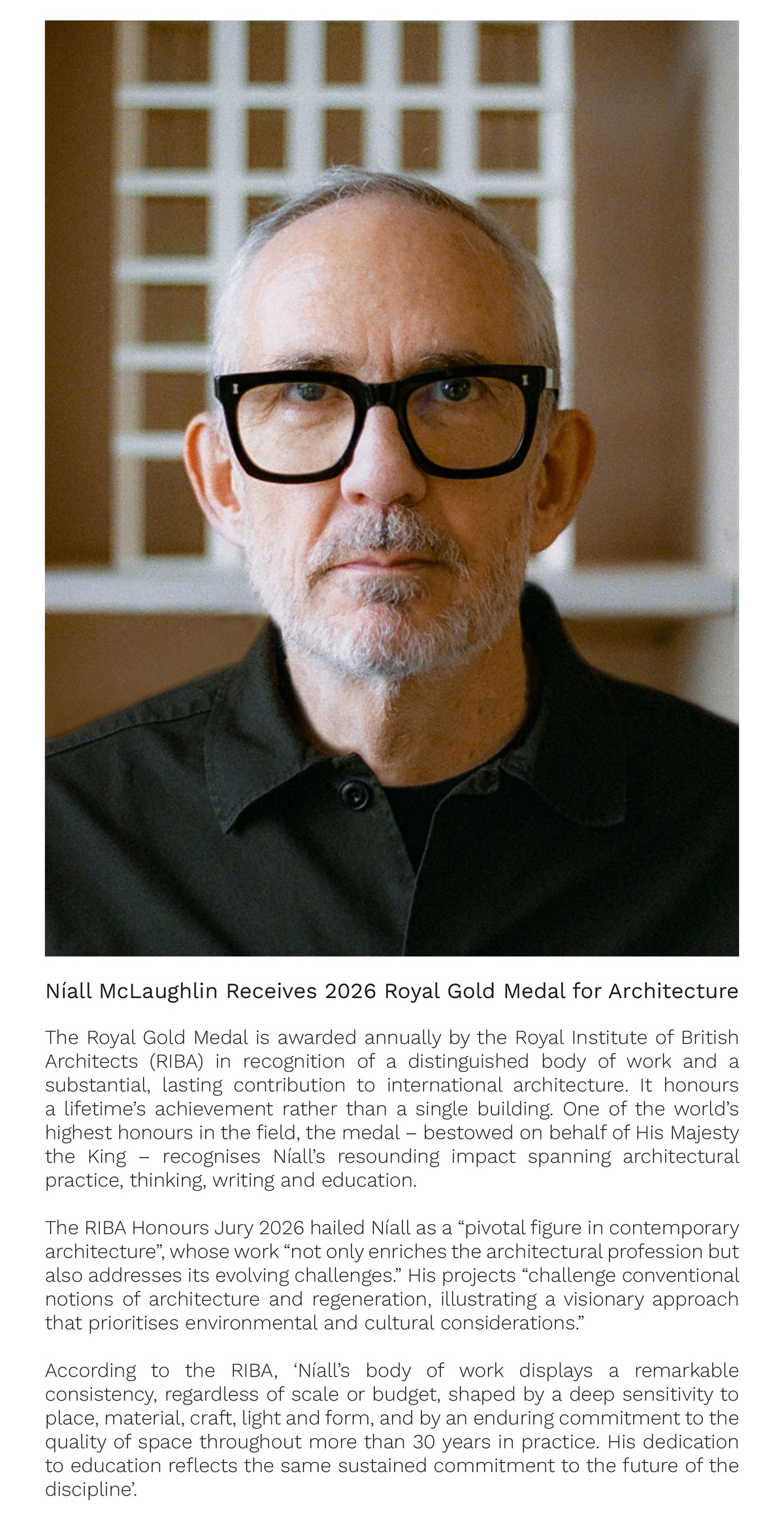
Established in 1990, Níall McLaughlin Architects is a London-based practice designing buildings for education, culture, faith, care, and housing, all grounded in an approach that sees architecture as learning, craft, and ritual that endures through human engagement and collective use.
Acknowledging the award Níall said ‘Architecture is a patient and ethical act, one that unfolds through care for people, places, and institutions, over time. To receive the Royal Gold Medal from a jury so deeply engaged in education, culture, and civic life is an honour that affirms these values. It encourages us to continue working with the same attentiveness, restraint, and responsibility that have shaped our practice from the beginning.’
RIBA President and Chair of the 2026 RIBA Honours Jury, Chris Williamson, said: “Always one to credit and uplift those around him, it is fitting that Níall is recognised for the resounding impact he has had on the profession. As an educator, he has been an outstanding role model for young architects, while his designs - eclectic in appearance and use - share a sense of care and grace that represent the very best of architecture.
Such sustained success has in no way diminished his humility. A humble visionary, his dedication to architecture as an art and professional practice has left an enduring mark on the discipline – one that will undoubtedly transcend trends and time.”
The 2026 RIBA Honours Jury was chaired by RIBA President Chris Williamson and comprised of 2025 Royal Gold Medal recipient Kazuyo Sejima of SANAA, Anna Liu of Tonkin Liu, Isabel Allen, Editor, Architecture Today and Victoria Farrow, Architect and Subject Lead in Architecture and the Built Environment at Leicester School of Architecture, De Montfort University.
Frameless Architecture
August 2015
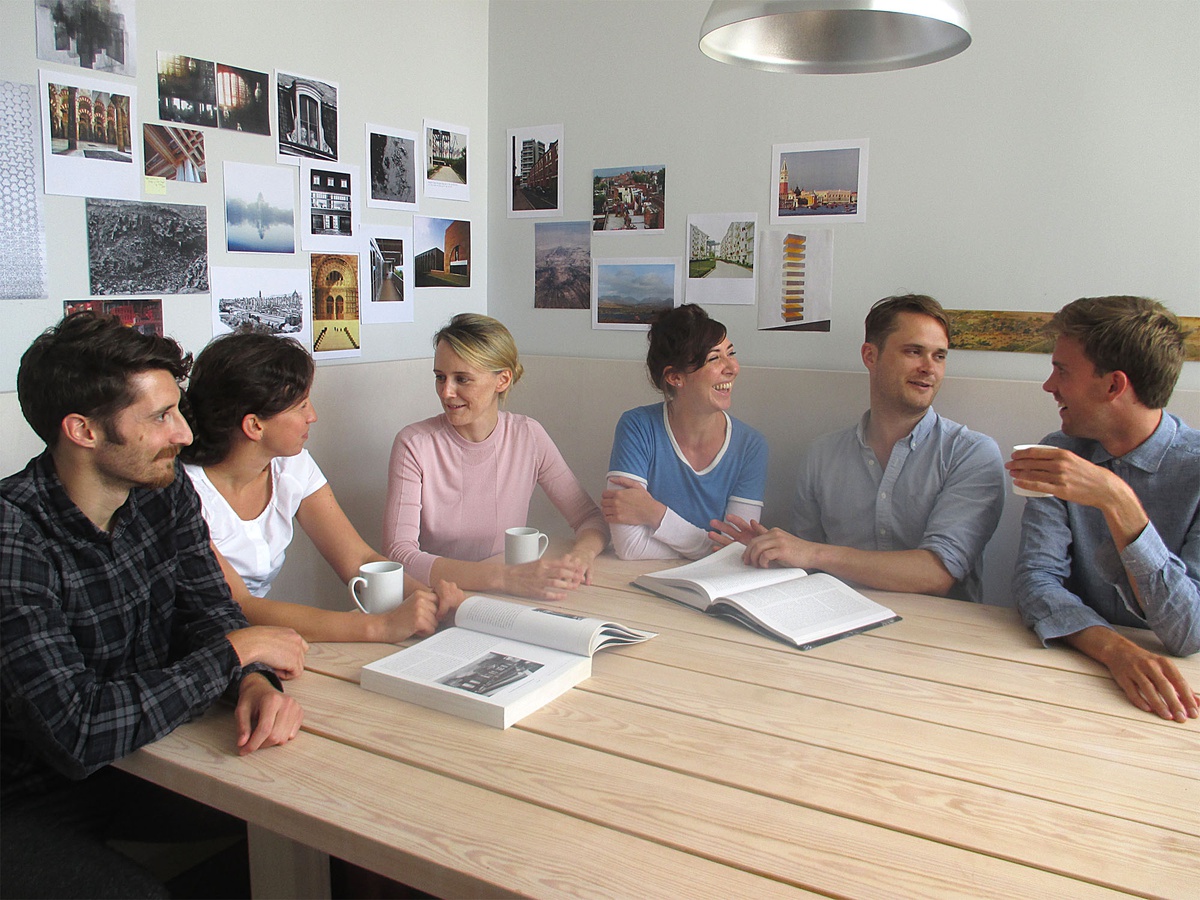
Our classification of the world is the result of a desire to impose order on the chaos we are born into. In nature we classify the species, in society we classify our relationships, and in architecture we classify the spaces we design and inhabit. In many cases, classification is a useful tool that allows us to root ourselves in time and space.
Classification can also be the enemy of imagination, suffocating our desire to wonder and discover new associations. It can limit the understanding of what surrounds us and disjoint elements that should not be separated. Framing perception can become a reductive force.
In his book Atlas: How to Carry the World on One’s Back, Didi Huberman uses ‘atlas’ in its broadest sense to mean a ‘collection of images’. Huberman explores two different ‘uses of reading’: a denotative sense in search of messages, and a connotative sense in search of montages. The dictionary is a predictable tool for the former, and the atlas is the ‘unexpected apparatus’ for the latter[1].
The atlas is frameless and endless. It surpasses boundaries and restrictions and is in a state of constant renewal. The atlas enables our imagination to trigger new associations, new relations. Although we may start with a search for the specific, we may then wander endlessly, unlimited by a defining frame.
Architectural education, architectural research and architectural practice have suffered for too long from being limited by a defining frame that has placed them in different dictionary entries. It is now time to rethink this model, which shapes our lives, our careers, and ultimately our contribution to society. If we are to replace the dictionary with the atlas, if we are to substitute the definitive meaning with the endless search for new relations, we will have a new model of architecture where education, research and practice are interwoven and intrinsic to one another.
For this new model to succeed, we must completely awaken our imagination. Education, research and practice will be symbiotic and won’t be understood without each other. As a result, transverse readings and meanings will develop within our work. These will be found not only in the individual but also in the collective. In our office, inspired by Aby Warburg’s Mnemosyne Atlas, we will develop our own Atlas where images of our endlessly evolving inspirations and aspirations will be captured. Our Atlas will be a new ground from which meaning, space and relationships will grow. Our Atlas will enable us to read what has never been written[2].
[1] Georges Didi-Huberman (2010). Atlas. ¿Cómo llevar el mundo a cuestas?. Madrid: TF Editores/Museo Reina Sofía . 16-17.
[2] Georges Didi-Huberman (2010). Atlas. ¿Cómo llevar el mundo a cuestas?. Madrid: TF Editores/Museo Reina Sofía . 14.