Níall McLaughlin Receives 2026 Royal Gold Medal for Architecture
January 2026
Established in 1990, Níall McLaughlin Architects is a London-based practice designing buildings for education, culture, faith, care, and housing, all grounded in an approach that sees architecture as learning, craft, and ritual that endures through human engagement and collective use.
Acknowledging the award Níall said ‘Architecture is a patient and ethical act, one that unfolds through care for people, places, and institutions, over time. To receive the Royal Gold Medal from a jury so deeply engaged in education, culture, and civic life is an honour that affirms these values. It encourages us to continue working with the same attentiveness, restraint, and responsibility that have shaped our practice from the beginning.’
RIBA President and Chair of the 2026 RIBA Honours Jury, Chris Williamson, said: “Always one to credit and uplift those around him, it is fitting that Níall is recognised for the resounding impact he has had on the profession. As an educator, he has been an outstanding role model for young architects, while his designs - eclectic in appearance and use - share a sense of care and grace that represent the very best of architecture.
Such sustained success has in no way diminished his humility. A humble visionary, his dedication to architecture as an art and professional practice has left an enduring mark on the discipline – one that will undoubtedly transcend trends and time.”
The 2026 RIBA Honours Jury was chaired by RIBA President Chris Williamson and comprised of 2025 Royal Gold Medal recipient Kazuyo Sejima of SANAA, Anna Liu of Tonkin Liu, Isabel Allen, Editor, Architecture Today and Victoria Farrow, Architect and Subject Lead in Architecture and the Built Environment at Leicester School of Architecture, De Montfort University.
Craftlines
August 2015
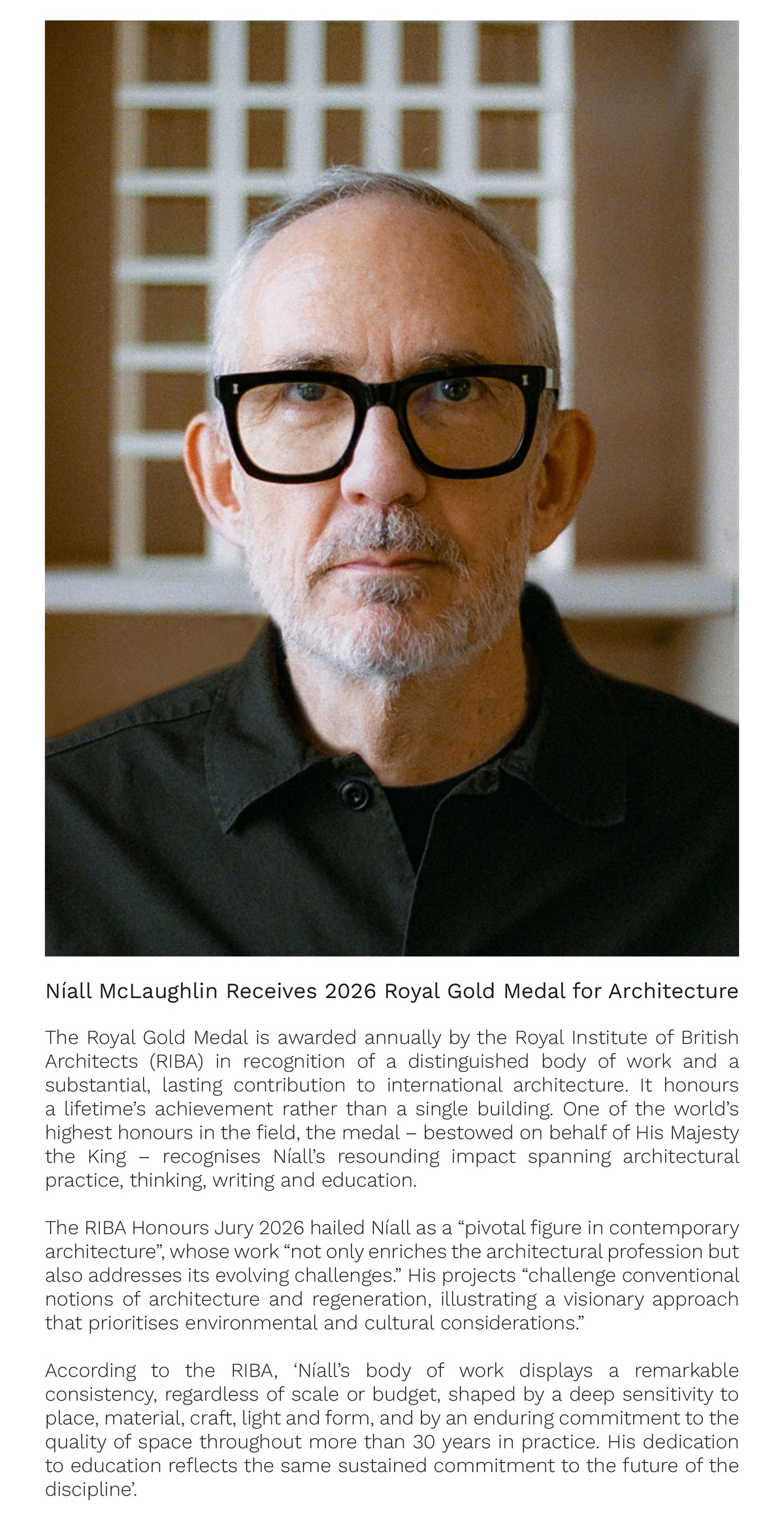
My grandfather has worn many hats; soldier, civil servant, father of seven, husband, and winner of a county final in hurling (the achievement of which he is potentially most proud). He is fluent in Irish and recalls event and dates from 50 years ago with a staggering accuracy. Yet the residing image of him from my childhood is as a craftsman – in the garage next to his house in Dublin, whittling and sanding a piece of ash to form a hurley, sizing it precisely for the user, wrapping the handle to create the perfect hold. I remember sitting, playing surreptitiously with a clamp, watching this in awe: the creation of the perfect instrument from a piece of timber; a skill honed through practice and an unfailing attention to detail. I marvelled at the assurance of it all, the promise in his hands.
It would be satisfyingly simple to attribute my choice of career to these moments – to claim there was an epiphany in watching him, a sudden realisation that I wanted to be an architect, to create. In reality, however, the path was not so linear; instead the conviction that I wanted to become an architect embedded itself in my consciousness slowly, over time. The memory of him working in his garage was one I didn’t return to often, and like any story we fail to repeatedly tell ourselves, it languished, dormant, in the recesses of my mind.
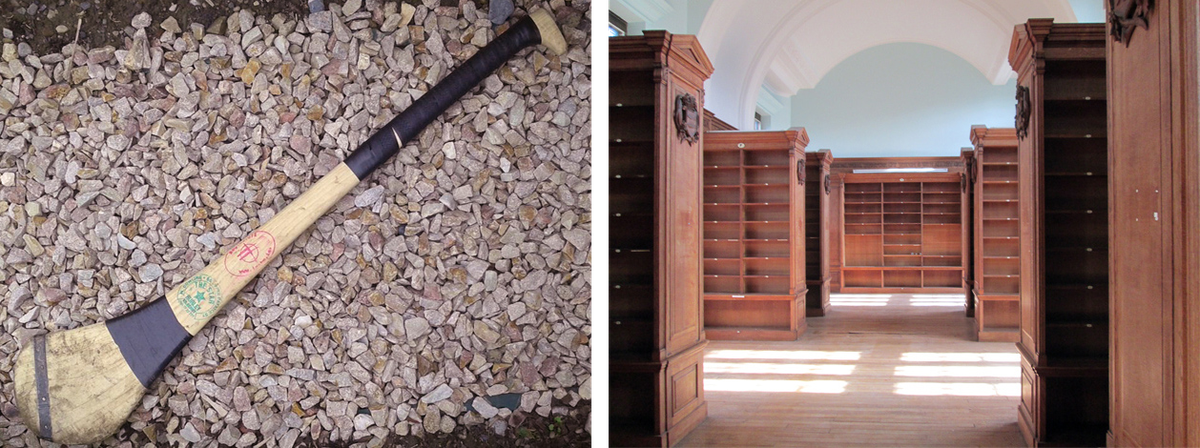
I recently went to site at Jesus College, Cambridge, where we are working on a project that is part new build, part refurbishment. An aspect of the refurbishment involves the adaptation of eight bookcases in the magnificent former library into wall panelling. The existing bookcases are a dark stained timber, designed by Maurice Webb in the 1920s and wonderfully crafted by a masterful hand. Reworking these without compromising their beauty would be a challenge for any craftsman.
On seeing the work the joiner had done, I realised there was no cause for worry – it had been executed with confident, competent hands. In that moment, the memory of my grandfather in his garage came back to me in glorious Technicolor; and I felt a familiar thrill at the embodied potential of the right material in the hands of a craftsman, with promise in his hands.