Níall McLaughlin Receives 2026 Royal Gold Medal for Architecture
January 2026
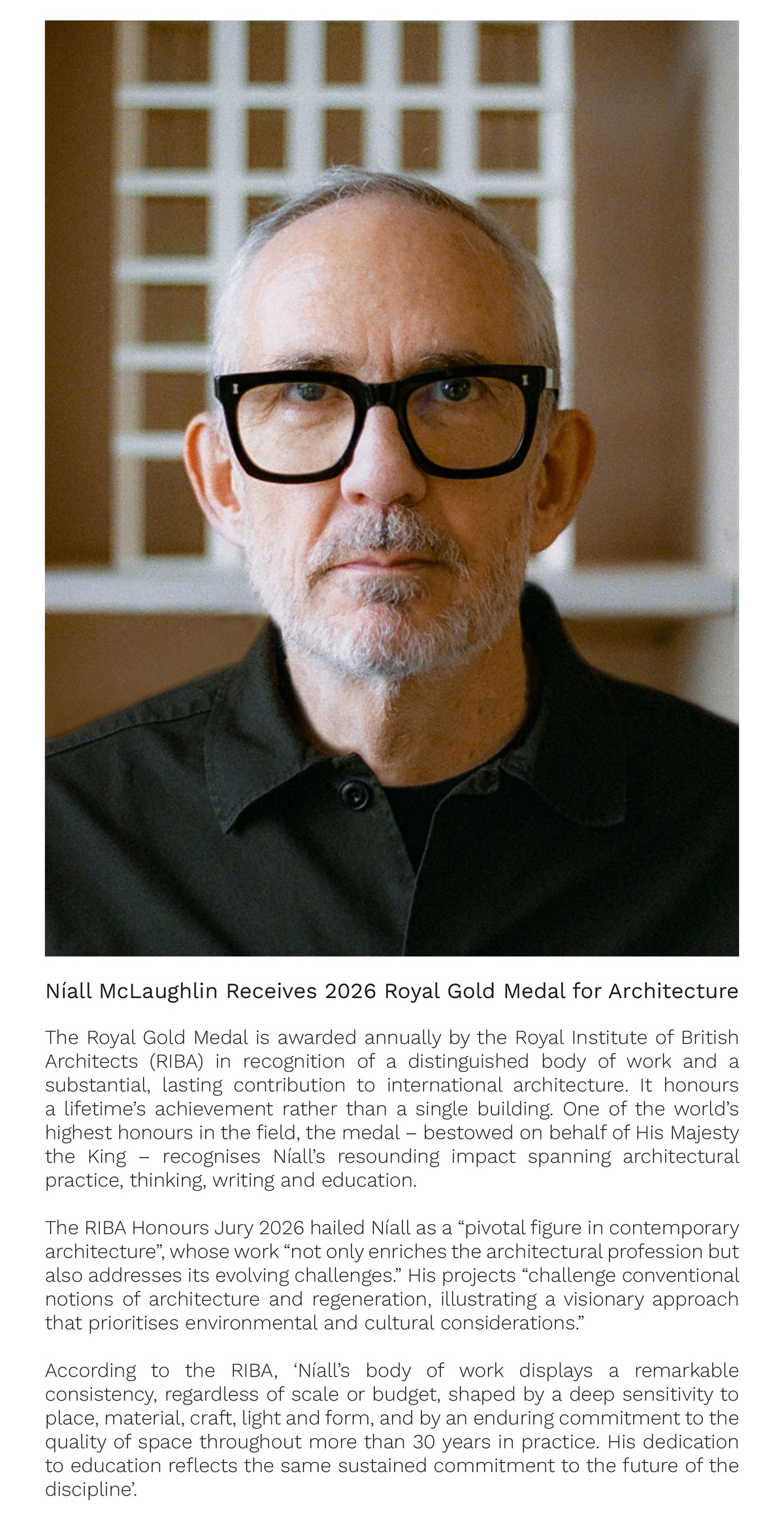
Established in 1990, Níall McLaughlin Architects is a London-based practice designing buildings for education, culture, faith, care, and housing, all grounded in an approach that sees architecture as learning, craft, and ritual that endures through human engagement and collective use.
Acknowledging the award Níall said ‘Architecture is a patient and ethical act, one that unfolds through care for people, places, and institutions, over time. To receive the Royal Gold Medal from a jury so deeply engaged in education, culture, and civic life is an honour that affirms these values. It encourages us to continue working with the same attentiveness, restraint, and responsibility that have shaped our practice from the beginning.’
RIBA President and Chair of the 2026 RIBA Honours Jury, Chris Williamson, said: “Always one to credit and uplift those around him, it is fitting that Níall is recognised for the resounding impact he has had on the profession. As an educator, he has been an outstanding role model for young architects, while his designs - eclectic in appearance and use - share a sense of care and grace that represent the very best of architecture.
Such sustained success has in no way diminished his humility. A humble visionary, his dedication to architecture as an art and professional practice has left an enduring mark on the discipline – one that will undoubtedly transcend trends and time.”
The 2026 RIBA Honours Jury was chaired by RIBA President Chris Williamson and comprised of 2025 Royal Gold Medal recipient Kazuyo Sejima of SANAA, Anna Liu of Tonkin Liu, Isabel Allen, Editor, Architecture Today and Victoria Farrow, Architect and Subject Lead in Architecture and the Built Environment at Leicester School of Architecture, De Montfort University.
A Style for our Times?
November 2015
“The way to make good architecture – that is, to respond with dignity to the relentless jostling of theoretical positions and of the buildings themselves – can be to say very little indeed and just to enquire into what a particular place might, by way of buildings, most need”
Niall Hobhouse in Translations: Florian Beigel and Philip Christou, Christoph Merian Verlag 2014
Each year the Stirling Prize shortlist sparks debate about contemporary architectural style and it was no different this year, particularly with such a distinctive set of buildings. The prize is “presented to the architects of the building that has made the greatest contribution to the evolution of architecture in the past year” and so any building shortlisted could be considered to exemplify a style for our times.
In practicing architecture I have been conscious of past and present styles or trends and how these influence design. The offices I have worked in each have different design styles and a different set of architectural references. This variety has enriched my experience of design; as a result, I do not consider myself to have a fixed stylistic agenda or claim a particular preference for one style over another.
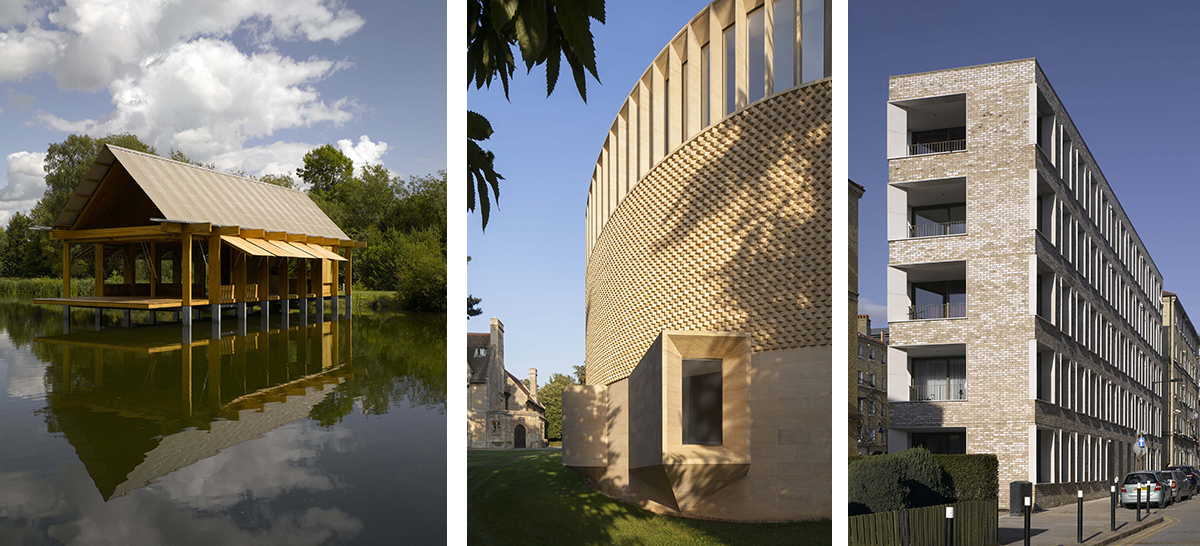
I have now been at NMLA for almost a year, working on one project but well aware of the rich variety in the practice’s past and present portfolio. Whilst there may be a discernible common language in the architecture, I would say this transcends any one particular style. To pick three of the most celebrated projects, the Chapel at Ripon College is very different to the Fishing Hut which is very different to Darbishire Place. Of course these buildings have different briefs but perhaps their ‘style’ is most significantly determined by the ‘place’ they inhabit (where ‘place’ refers to location and context – physical, social, historical and political).
The Chapel sits on a sensitive site. It must respond to its bucolic setting in a clearing amongst trees, the historically-significant college building stock behind and the views to and from the valley below. The Clipsham stone is in keeping with the Limestone of the other college buildings. The smooth base helps ground the building in its natural setting whilst the rough-cut dog-toothed stone alludes to the craft evident in the historic buildings nearby and has an organic quality whose textured surface perfectly captures the shadows of the trees. The clerestorey windows glow as a halo and act as a beacon on the hill when seen from the valley below. Rowan Moore described the chapel as sitting “comfortably amid Cotswold scenery and gothic revival architecture”.
The Fishing Hut is set in the landscape, between water and sky. Its simple form and construction are familiar to rural or agricultural settings but the level of craft and its quality materials make it delightful for the user, elevating it beyond purely functional. With its operable screens and shutters, it is both solid and transparent, as much about shelter, security and shade as it is about light, air and opening up to the landscape it inhabits.
At Darbishire Place the new brick block reflects the massing and characteristics of the existing Peabody estate blocks. The brick selection and white precast concrete window surrounds complement the brick and white-painted window reveals of the Edwardian buildings around the courtyard. Inset balconies enable the new façades to have a flatness akin to those of the surrounding buildings. A simple kink in building’s footprint allows the block to work with its context on both sides – a longer elevation addresses the street while a more compact elevation works with the proportions of the other courtyard façades. This kink also provides a route in from the street and so the new block can complete the courtyard without closing it off.
In terms of these three buildings, it is perhaps more difficult to identify a common architectural language than to comment on how they respond to place. I think they are all concerned with light and shadow and each display a level of craft in their execution. For me though the architecture of each project has a fineness. The fragile crown of stone fins and frameless clerestorey windows at the top of the chapel; the intricate timberwork, lightweight permeable envelope and the slight cantilevered deck hovering over the water to the front of the fishing hut; and the open corners and slender corner posts containing the inset balconies to Darbishire Place. It is these moments of finesse that unite the three buildings and other projects in the office.
Style has played an important and often polemical role in the development of architecture over the last 150 years. However, whilst we can entertain debate about a cycle of trends in design, what style is ‘now’ and what is coming next, it seems more pertinent to be aware of the wide variety of styles and take influence from sources that are most appropriate to any one project’s place.
In the same vein as the opening quotation, we should not be concerned with a particular style for a particular time, but rather a particular style for a particular place.