CIVIC TRUST AWARD WINNER
MARCH 2022
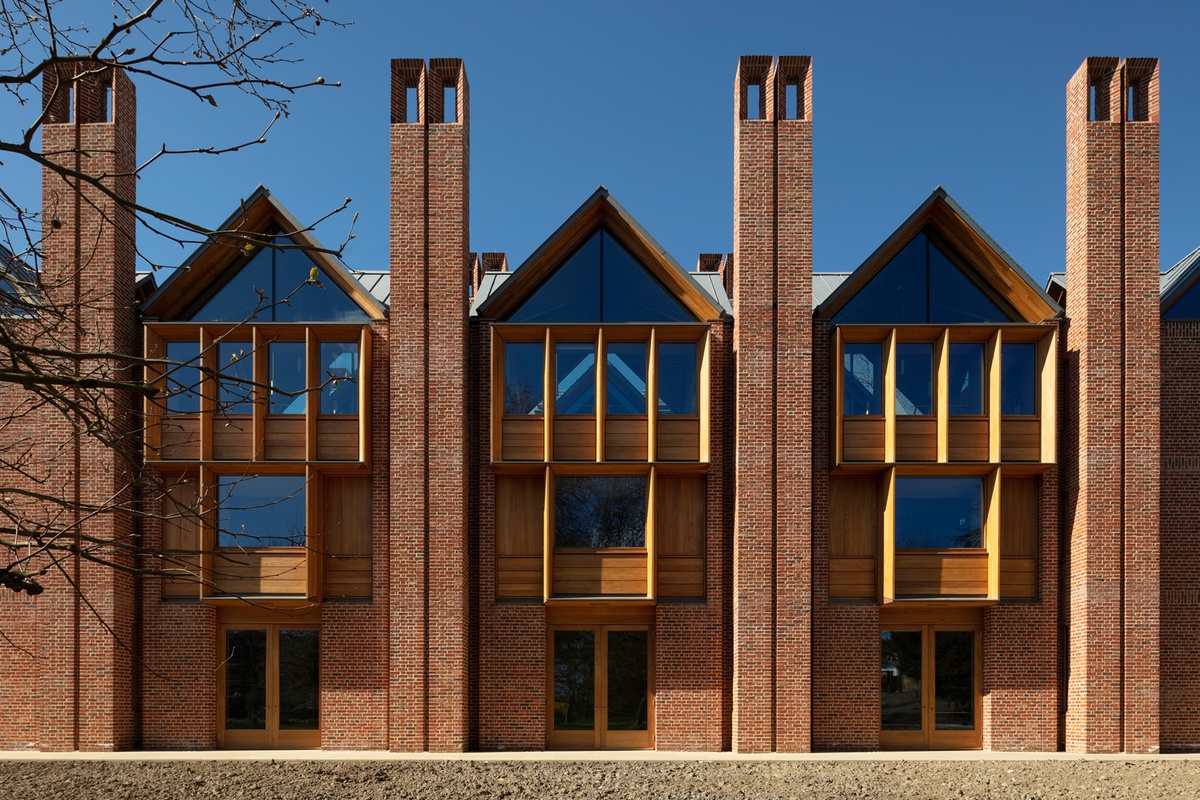
The Civic Trust Awards scheme was established in 1959 to recognise outstanding architecture, planning and design in the built environment.
The longest-standing built environment awards in Europe, their aim is to encourage the best in architecture and environmental design and to recognise projects that offer a positive cultural, social, economic or environmental benefit to their local communities.
The New Library was announced as the Eastern Winner from 160 entries from across the UK and Internationally. The judging panel commented: “The execution of the new library and its relationship with Magdalene College is delightful and appropriate and will be enjoyed by the college for many years to come.”
Fellow and Chairman of Cloverleaf, Professor Tom Spencer (1973) said: “We are so delighted with this Civic Trust Award which confirms what we already know - a brilliant building that works so well for us in so many ways."
LARGE-SCALE MODEL MAKING
SEPTEMBER 2014
The use of physical models by architects is well established, and can be seen throughout history as the natural partner to drawings for exhibiting a proposal of the building prior to construction. Within our practice, models are rarely produced as mere presentation pieces, but rather as tools for exploration. This role makes them less precious and complete, with the ability to change and adapt the design following the feedback that the model has initiated.
The type of models that I enjoy most are those of a larger scale, of 1:20 and above where you are able to get your head inside and truly appreciate the space. In addition to the final form of such models, much is learnt through the process of construction. Structure, surfaces and junctions are some of the issues that require resolution during the making of the model. Within our studio space, we have a large area dedicated to model making, which allows for building and display of sizeable pieces.

During our work on a new build private residence in Hampshire, we carried out much of the design work on the external envelope through the use of physical models. They were worked up in increasing scales including a 1:10 piece of the facade. In particular, we were considering the form of the heavy external piers, fascias and cornices against the lighter timber elements that sat within them. We made the model using a similar sequence to the proposed building construction. We put the more solid facade elements in place so that we could begin considering a number of different forms for the timber window framing that sat within. The glazing was again produced in a similar method to the full-scale building, with a timber-framed bay built separately prior to installation in to the existing facade. We fixed these delicately so that removal would be possible.
We worked on a number of iterations of the window form, adapting the frames and constructing new versions when modification was not possible. Each time, the model was left on display within the studio so that everyone in the practice could consider the alternative versions and provide feedback. Once we had a favoured form, we used the same model to illustrate the proposal to the clients for approval.
I believe that such iterative assessments and amendments would only have been possible through the use of a large-scale physical model. Building models is about constructing space, and many of the activities are similar in technique and execution as the construction of a real building. By carrying out these actions in miniature we may appreciate the building as a physical form and understand the three dimensional mass. Building of models is our primary opportunity to test and refine our building form, whilst experiencing and discovering an approximation of the processes that will be required to make it.
Alastair Crockett studied at the University of Bath, University College London and London Metropolitan University. Since joining Niall McLaughlin Architects in 2012 he has worked on the T1 building in King’s Cross; a private residence in Hampshire and the Nazrin Shah Building for Worcester College in Oxford.
