Arch-ive Interview
June 2020
On Tuesday 23rd June at 19.00, Arch-ive will be speaking to Níall McLaughlin about the literature that has influenced his practice, as part of the Architecture Foundation’s ‘100 Day Studio’.
Arch-ive is an online platform that investigates the books that have been influential to leading practitioners. It aims to showcase architects’ relationship to books and the way they utilise, interrogate, and display architectural resources.
The ‘live’ interview will take a slightly different format, focusing on specific buildings completed by Níall McLaughlin and the literature that surrounded their investigation. The discussion will focus initially on the Alzheimer’s Respite Centre in Dublin and Níall McLaughlin Architect’s work at the 2016 Venice Biennale, ‘Losing Myself’. Secondly, the conversation will focus on three projects from Níall’s early career, ‘The Shack’, ‘Phototropic’, and ‘Wandsworth House’. Finally, we will discuss ‘Bishop Edward King Chapel’ in Oxford.
Niall McLaughlin writes LA Article for Architectural Review
September 2013
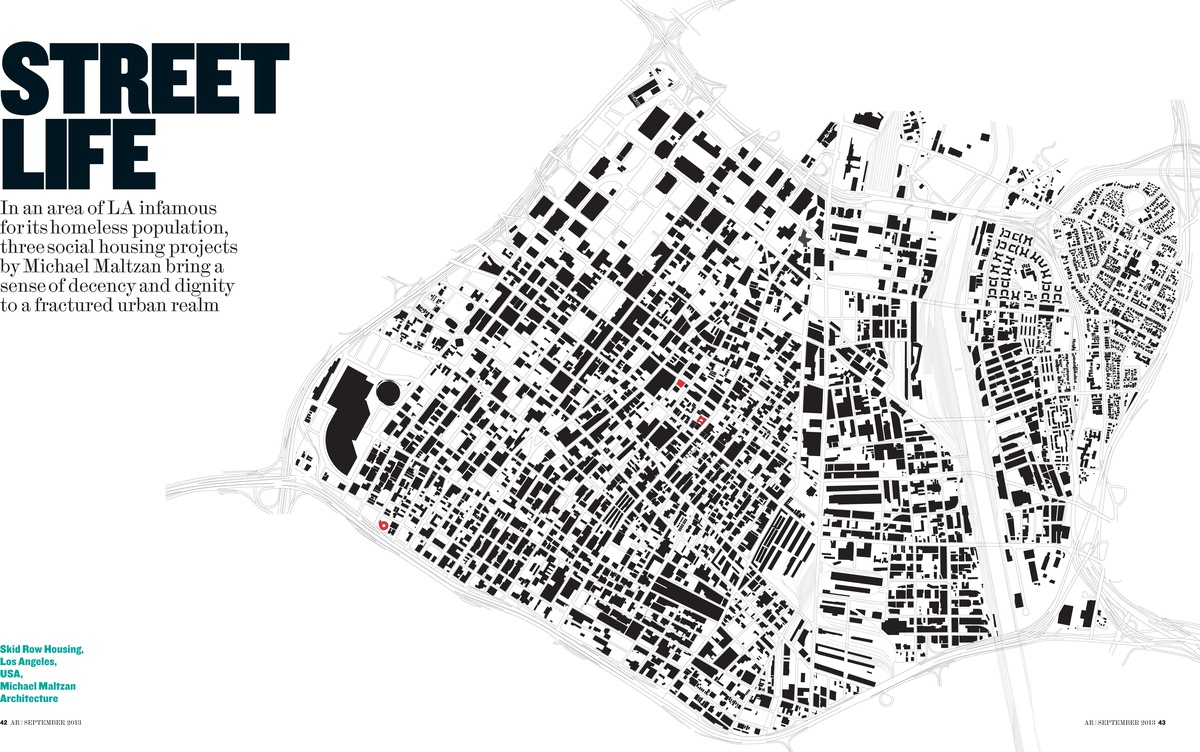
Niall McLaughlin has written an article for the Architectural Review, entitled ‘Street Life: Michael Maltzan’s Social Housing in Los Angeles’. The piece examines the history of the infamous area of LA known as Skid Row and three housing projects by the practice Michael Maltzan Architecture for this fractured part of the city. The piece draws out common themes between the projects, which are all low-cost accommodation for the previously homeless, exploring the successful spatial relationships between the private space of the individual rooms, the areas of common sheltered space and the public realm of the street.
“The formal virtuosity of each composition is Maltzan’s own special skill and they suggest that high architecture can give pleasure and dignity to all of us….I hope that the different spatial experiments, linking and articulating pavement, common sheltered space and private rooms, will become subjects for further reflection and analysis. It speaks of our common need to situate ourselves and participate in public life.” NM