A STONE GLOSSARY
MAY 2018
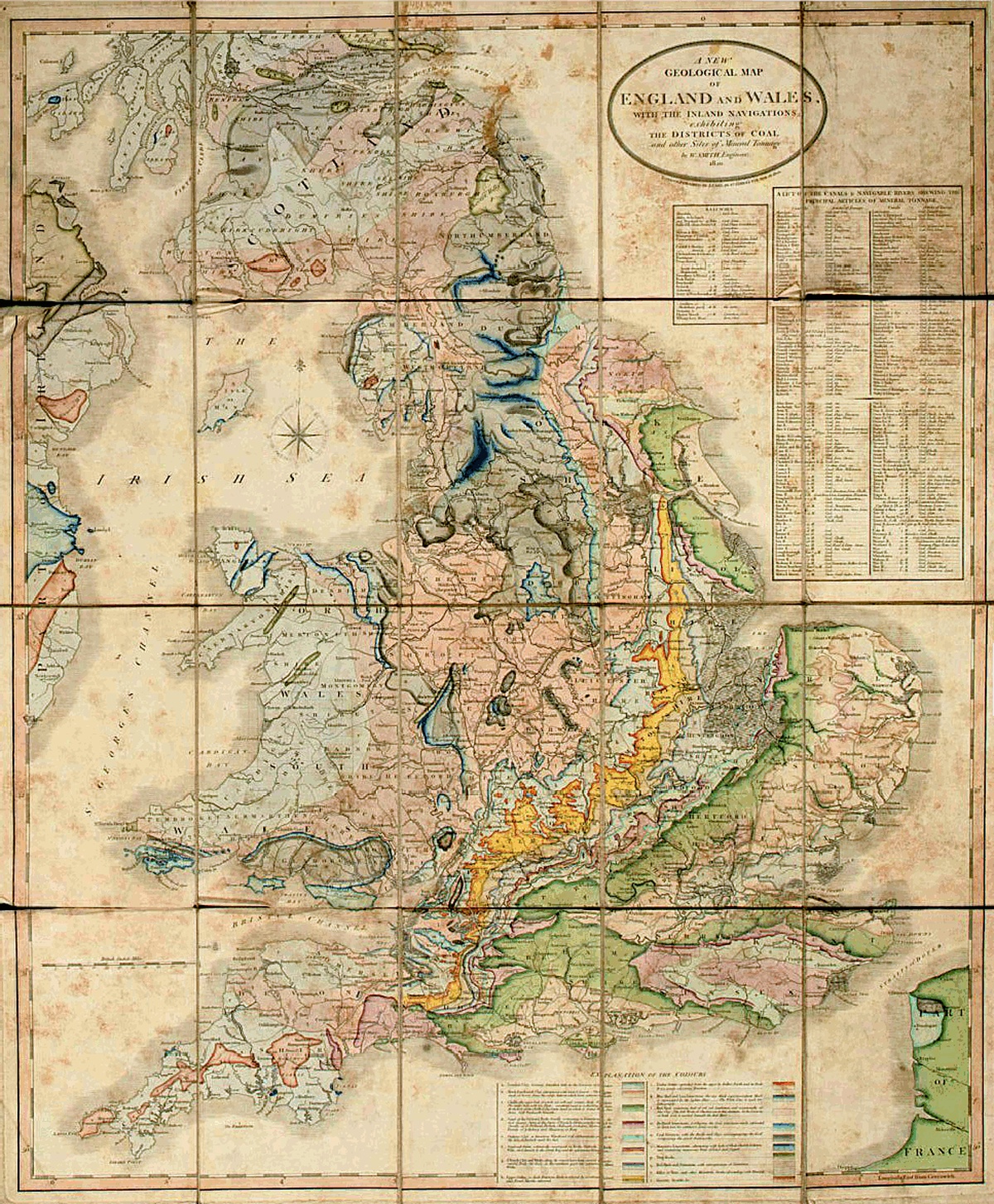
William ‘Strata’ Smith’s 1815 Geological Map, the first nationwide geological map ever published.
We are in the process of choosing the stone to be used for a new building in Cambridge. It has been an apparently exhaustive journey through marbles and limestones from the UK, Europe and beyond. We amass endless samples, and talk in detail to quarrymen, masons and engineers about bed heights, weathering, and reliability of supply, as well as the inevitable costs to quarry the stone, cut it to shape, and fix it together to form a building. One of the most fascinating elements of this process are the specialist terms used to describe building stones and their properties. Below is a list of a few favourite words, ordered to explain the material properties that have so far governed our explorations for this new project.
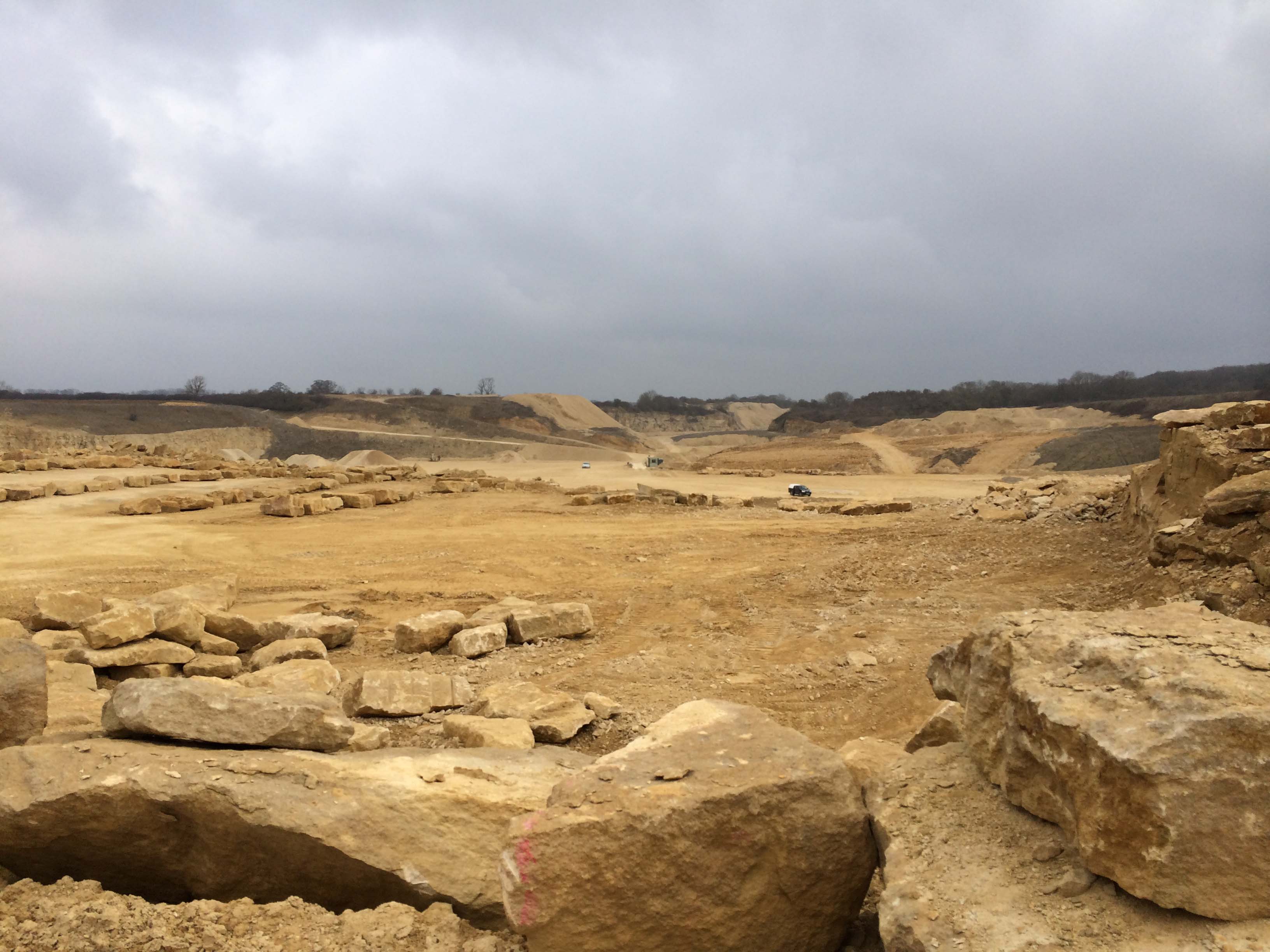
The Clipsham Quarry at Rutland in Lincolnshire. Clipsham Stone occurs in the Inferior Oolite of the Jurassic System, where it was laid down between 174 and 163 million years ago. Clipsham is a popular building limestone with a characteristic golden colour. We have recently worked with it at Bishop Edward King Chapel in Cuddesdon and the Sultan Nazrin Shah Centre in Oxford.
Bedding plane
Many building stones, including all limestones, are sedimentary rocks, formed by the gradual settlement and compression of underwater sediment over millions of years. The directional way in which they were formed governs their properties and how they can be used as building stones. Most UK limestones must be used ‘naturally bedded’, i.e. orientated in the building in the same way that they were formed in the ground. This means the height of the blocks is limited to the depth of the bed, rarely more than 1m in the UK. ‘Face-bedding’, when blocks are laid so their bedding planes are parallel with the vertical face of the block, can lead to rapid weathering and crumbling.
Metamorphic
A stone that began as another type of rock and changed as a result of exposure to heat and pressure over geological time. Marble was originally limestone, and is chemically identical to it. However, the metamorphic processes changed its physical properties so that it does not have bedding planes, and can be cut and orientated in any direction. This makes it ideal if tall blocks are required.
Precipitation
The chemical process by which Travertine is formed, usually when geothermally heated water is exposed to the air, causing it to degas and carbonate minerals to precipitate out from the water. Although a type of limestone, its distinctive formation means it also doesn’t have bedding planes and is workable in much longer, thinner pieces than sedimentary stones.
Oolitic
A type of limestone made from an amalgamation of individual grains called ooliths. An oolith is a tiny carbonate particle surrounded by concentric layers of calcium carbonate, which were deposited as the ooliths were rolled around on the bed of the clear shallow sea in which the stone was formed. This gives the stone an even structure so it can be cut or sculpted in any direction, a characteristic which makes oolitic stones ‘freestones’. Portland Stone is an oolitic limestone used extensively in London’s historic buildings, perhaps most famously in churches by Cristopher Wren and Nicholas Hawksmoor, including St Paul’s Cathedral and Christ Church Spitalfields.
THE RED HOUSE
JULY 2014
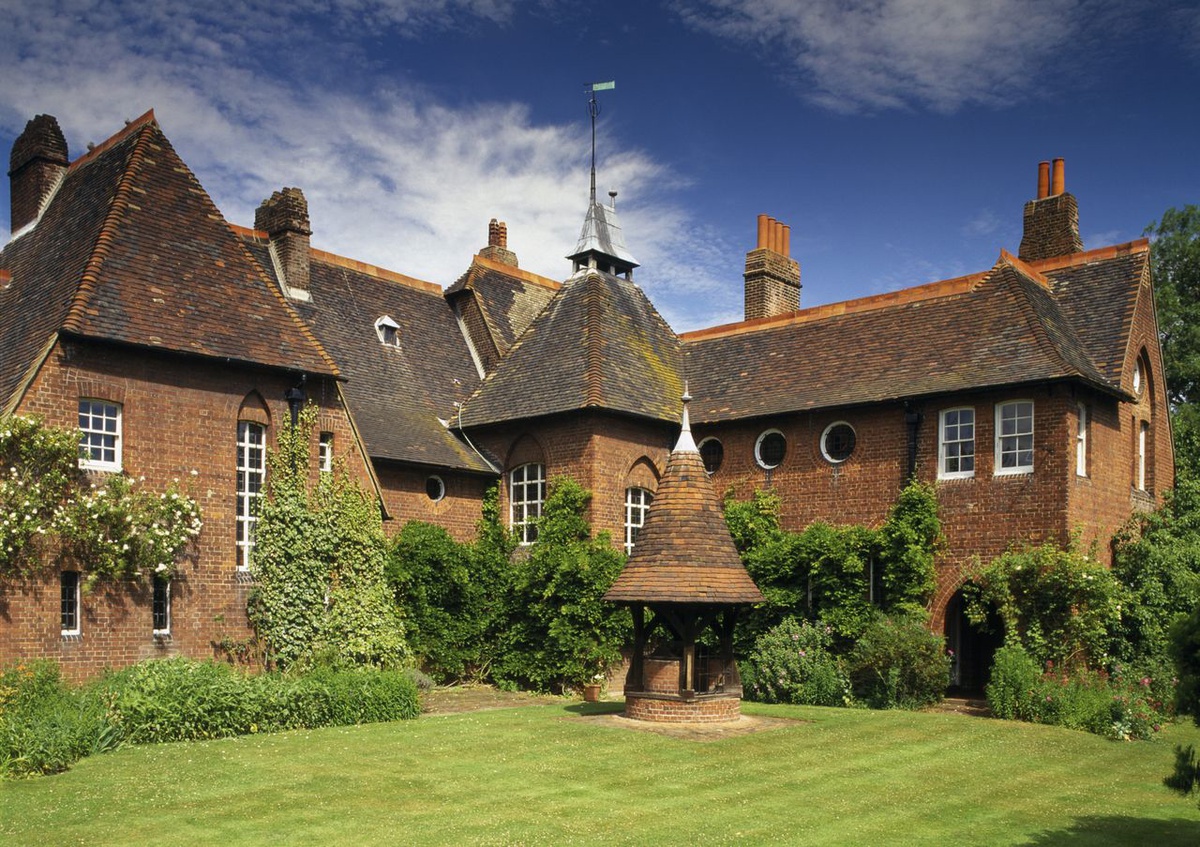
A group of us from the office recently went to visit William Morris’ Red House. I was inspired by a picture of a red house on the cover of Peter Davey’s book ‘Arts and Crafts Architecture’ so was slightly disappointed to find that those fine chimneys were the work of Edwin Lutyens and not Philip Webb. It was an interesting trip none the less.
The Red House was designed in 1859 by Philip Webb for William Morris. The two had met in the office of G.E. Street in 1856 during Morris’ brief architectural career. The house can be thought of as a bridge between the ‘Gothic Revival’ as epitomised by the ideals of Pugin and the ‘Arts and Crafts’. 50 years after its construction Lawrence Weaver wrote about The Red House ‘It stands for a new epoch of new ideals and practices. Though the French strain which touched so much of the work of the Gothic Revivalists is not absent, and the Gothic flavour itself is rather marked, every brick in it is a word in the history of modern architecture’.1
The Red House is something of an experiment, built by a young and relatively inexperienced architect, and as such is not a refined piece of architecture. Webb later remarked with reference to The Red House ‘…no architect ought to be allowed to build a house until he was 40’. 2
Despite Webb’s young age the experimental feel of the building is probably more to do with the client. Morris would have been incredibly ambitious and perhaps a little impractical. As our tour guide explained the principal rooms of the building face North to address ‘The Pilgrim’s Way’, an ancient route from Winchester to Canterbury as mentioned in Chaucer’s ‘The Canterbury Tales’. Our guide took great glee in explaining that this eccentricity led to the building being terribly cold, an example of Morris’ ideas overruling common sense. Peter Davey offers a simpler explanation in that Webb was following the Georgian fashion of the principle rooms facing North, whilst also allowing space for the connection of a future East wing for Morris’ friend Edward Burne-Jones and his wife Georgiana.3
To say that the Red House is unrefined, however, is to miss the point of what makes it so significant. It is the physical embodiment of a group of young designers and thinkers who went on to change the face of British art, design and architecture. They were inspired by a nostalgia of a reimagined medieval England, and it was in the past that they found the clues to pave the way for the Arts and Crafts.
This interest in an older England was not unique to Morris as Ian Hislop explains in his recently broadcast BB2 series ‘Ian Hislop’s Olden Days’, which places Morris’ aesthetic interest in the medieval into a broader social and political context. The description of the second episode, ‘Forward into the Past’ is as follows:
Forward into the Past – How the Victorians turned to the Middle Ages to make sense of their era of progress.
‘Ian Hislop travels back to the era of the Industrial Revolution and Victorian Britain. This was a time of some of the greatest progress and modernisation the country had ever seen – and yet, throughout these decades, writers, artists and politicians were trying to make sense of this new world by retreating into a very old world indeed: the Middle Ages.’
The point that Hislop makes is that we take comfort from the cultural signals that remind us of ‘the good old days’ weather they be the idea of chivalry, the Robin Hood politics of ‘take from the rich and give to the poor’ or the truth and beauty inherent in a gothic arch. For the Victorians the golden age was the medieval period so I wonder what it could be for us today.
In architecture we often talk about truth to materials and the expression of a building being honest to its construction. These ideas were central to the thinking of Morris and Webb’s predecessor, A.W.N. Pugin. In his book ‘The True Principles of Pointed or Christian Architecture’ he writes:
‘The two great rules for design are these: 1st, that there should be no features about a building that are not necessary for convenience, construction or propriety; 2nd, that all ornament should consist of the essential construction of the building. The neglect of these two rules is the cause of all the bad architecture of the present time.’
These words seem as relevant today as they were when first written, although our mental picture on reading them may be somewhat different. Perhaps Pugin’s time and the generation that followed could be thought of as an architectural golden age. In architecture school the Victorian period is an interesting piece of history but not relevant to modern design, but might it be ok to take some inspiration from these great designers?
The idea of any given moment in time looking back to a golden age reminds me of the plot of Woody Allen’s film ‘Midnight in Paris’ which Wikipedia notes ‘The movie explores themes of nostalgia and modernism’
Gil Pender travels back to his Golden age, 1920’s Paris where he socialises with the likes of Hemmingway and falls in love with the beautiful Adriana. All’s well until they are transported back to Adriana’s golden age, the 1890s Belle Époque and Pender realises that a golden age can only ever exist in the past.
If time travel were possible we would only ever be chasing rainbows.
When we build in an historic environment or we are looking to create a sense of place we turn to local materials and traditional construction techniques. These offer us a connection with the past that is important for reasons that I can’t begin to explain but which I acknowledge as being real and significant.
It seems to be becoming increasingly acceptable within contemporary architecture to address issues of nostalgia and modernism but our recent brush with post-modernism has made us cautious in our approach. As we venture once more in this direction we would do well to remember the lessons of Pugin, Allen and Hislop.
1. Weaver, Lawrence Small Country Houses of Today, First Series, Country Life, London, nd, p180.
2. Jack, George ‘An appreciation of Philip Webb’, The Architectural Review, Vol XXXVIII, 1915, p3.
3. Davey, Peter Arts and Crafts Architecture, Phaidon, 2010, p40.
Tom studied at the University of Manchester where he received a BA (Hons) and a diploma with Distinction at the Glasgow School of Art. He won the Royal Scottish Academy Student Prize for Architecture in 2006 as well as the Glasgow City Council Silver Medal, Glasgow School of Art Chairman’s Medal and Glasgow Institute of Architects’ Parchment. Between 2006 and 2013 he worked for Duggan Morris Architects and Rick Mather Architects. Tom joined Niall McLaughlin in 2014 and has been working on a private house in Hampshire and is currently running the Jesus College project for the master plan and first phase of development to add research, social, academic and residential accommodation to the College facilities.